| PSP: | 000010 |
| Title: | Bounded Search Trajectories and Model-Conditioned Prompt Programs |
| Author: | Vikrant Rathore (@vikrantrathore), Ronak Rathore (@ronakrathore) |
| Status: | Draft |
| Type: | Enhancement |
| Created: | 2026-08-17 |
| Discussion-To: | https://github.com/eonseed/perspt/discussions/PSP-10 |
| Extends: | 000008, 000009 |
Abstract
Perspt admits a state only after a deterministic gate accepts it. It mediates every effect through the admissibility kernel. It records the evidence for each decision. PSP 000009 made these rules part of the running system.
The gate is not a search method. A coding task may have many plausible paths. Most paths fail. A useful harness must explore some of them without treating every intermediate edit as progress.
Models also differ. They were trained and post-trained on different data. They may respond best to different instructions and tool descriptions. One prompt should not be assumed to fit every model family.
This PSP adds two mechanisms. It does not change the acceptance rule.
A bounded search forest explores isolated branches. Every branch has the same accepted ancestor xk. A root branch starts there. A child branch may start from a content-addressed partial checkpoint made by its parent. A branch may regress or fail. Its intermediate states are not accepted states. The runtime measures branch candidates against the same accepted root. It selects one eligible candidate by a deterministic rule. Only that candidate is committed through the ordinary gate.
A model-conditioned prompt program presents typed state to a model. A program is composed from small, single-concern prompt sections: human-readable markdown files with typed front matter, compiled at build time into typed Rust values.
perspt-sdkdefines the section, composition, and digest primitives; a small codegen crate turns section files into typed structs so that a malformed edit failscargo build, never a session.perspt-coreowns the platform section library. Each domain package owns its domain sections.perspt-agentcomposes both programs at each actor call site. There is no template engine and no prompt database.
Prompt selection uses the transport adapter and the model family. An exact model may override that choice. A configured endpoint name never selects a prompt. Endpoint names identify locations and credentials. They do not identify model behavior. Structural differences between model families - tool-call convention, reasoning-trace handling, and system-slot layout live in a typed model dialect, never in forked prose. Family-specific prose exists only as single-section overrides gated by measured evidence.
A compiled program records its dialect, its ordered section identities, versions, and content hashes, its rendered hash, its dropped-section set, and its tool specification hash. Replay reconstructs the exact messages that Perspt supplied to its transport. It does not claim knowledge of instructions or changes inside a remote service.
The design keeps three objects separate:
the accepted trajectory A;
the speculative forest ℰk; and
the prompt program πa, f, m, s.
The formal model gives six checkable results. Search does not add accepted gate decisions. Discarded branches do not change the accepted projection. Search terminates under a finite budget. Prompt and search state replay without new model calls. Resident context fits a declared bound and replays from content-addressed pages.
This PSP also fixes six defects found in PSP-9. It enforces the finite decision
bound, wires HardGatePolicy into candidate measurement, sends architect
graph updates through the admissibility kernel, keys accepted replay by
candidate identity, parses structured verifier output, and replaces duplicated
actor loops with one ActorTurnRunner.
A typed CorrectionPacket carries verifier structure to the next search
quantum. Concrete counterexamples, when a verifier can produce them, guide
the next issue-specific prompt plan. Ordinary diagnostics remain correction
evidence; the PSP does not mislabel them as formal counterexamples. A bounded
working set keeps current evidence resident and moves older material to a
content-addressed backing store.
A graph staging root holds node winners until a full integration check passes. Six implementation choices are fixed: branch workspaces are sequential eager copies, no-goods are exact, runtime events use one versioned envelope, prompt text is compile-time typed with no template engine and no prompt database, context uses deterministic paging, and divergent prompts require measured activation evidence.
The old ensemble and exploration APIs are replaced by this search plane. The
change is intentionally breaking. simple-chat remains unchanged.
Motivation
Verified Completion Without Search
The gate is a filter. It is not a generator. PSP-9 gives the loop one candidate workspace and one correction channel. The loop measures, corrects, and tries again. A weak correction often produces a weak variation of the same idea.
The current ensemble adds only route diversity. It runs at the Refine rung. Every arm receives the same prompt. Every arm also pays for a full loop. The runtime does not preserve useful evidence from a failed arm.
A search plane solves a different problem. It tries bounded alternatives before one of them reaches the gate. A branch may use a new strategy, route, or prompt program. It may regress inside its private workspace. It may fail completely.
This does not weaken the papers. Paper II constrains accepted transitions. Paper III constrains every effect. A private branch may move uphill, but it must still use mediated effects and attenuated capabilities.
One Prompt Is Not Enough
The agent has five main inline prompts.
Actor |
Site |
Defect |
|---|---|---|
Worker |
|
Says “governed coding agent” for every domain. |
Adjudicator |
|
Contains a handwritten JSON shape. The domain hook is not called. |
Architect |
|
Its JSON example can drift from the tool schema. |
Explorer |
|
Inline literal. |
Summarizer |
|
Inline literal. |
There is no prompt compiler in this path. There is no model-family routing. The correction channel also drops paths, symbols, and rationale. The richer language-specific correction methods are used mainly by tests.
Comparative harness study suggests useful engineering hypotheses. Models may benefit from route-specific instructions. Narrow stages may be easier to test than one large prompt. Tool descriptions form part of the model-facing interface. These observations motivate experiments. They do not define Perspt’s architecture. The mathematical gate, effect kernel, replay rules, and domain contracts remain the foundation.
What PSP-9 Left Unwired
The audit found six concrete defects.
The finite-decision bound is not enforced.
AcceptedTrajectory::decision_boundandperspt_agent::toolloop::loop_decision_boundare called only from tests. The doc comment on the latter claims “exceeding it fails the run”; no production path checks it. The loop is bounded bymax_turnsand the rejection budget.The hard-gate policy has zero runtime consumers. Both domain packages declare
HardGatePolicy::required_stages; the measurer ignores them and computeshard_passfrom the plugin verifier profile (crates/perspt-agent/src/candidate.rs). A domain cannot currently make a declared stage authoritative.The architect bypasses the kernel. The planning turn invokes the
update_graphtool spec directly over the transport, outside the tool loop. The result is schema-validated. No capability is checked, and no admissibility witness is produced.The accepted fold collides candidates.
replay_accepted_trajectory(crates/perspt-sdk/src/ledger.rs) keys candidate energies by(node_id, generation); an ensemble round runs several candidates at the same key. Their measurements may overwrite one another. The gate event also omitsobserved_energyandbest_accepted_before.Diagnostics are scraped, not parsed. Rust diagnostics are recovered by
strip_prefix("error[")over stdout lines; Python by lowercase substring match; every residual is emitted withscore = 1.0and severityError.EvidencePayload::rawandEvidencePayload::structuredare not populated.Five duplicated actor loops. Only the worker has failover, compaction, ledgered context deltas, and typed
TurnObservedrecords; the explorer, architect, adjudicator, and summarizer each implement another loop.
These defects are prerequisites. The implementation fixes them before it adds search behavior.
What the Papers Require
Four rules from the papers constrain this design.
Finite acceptance. An authoritative commit uses one gate decision. Speculative measurements use search budget. They do not alter the accepted trajectory.
Effect mediation. A branch uses the ordinary admissibility kernel. It receives no promotion authority.
Replay. Search and prompt provenance enter the ledger. Replay uses recorded model and sensor observations.
Dependent actors. Model-family diversity is a search prior. It is not an independence certificate. Selection uses verifier measurements, not votes.
Formal Model
This section defines the objects used by the design. It then states the properties that the implementation must test.
Objects and Notation
Let X be the set of realized workspace states. Each state is a content-addressed snapshot over a canonical scope. Fix a node generation with baseline energy V0, gate margin ρ > 0, and rejection budget B.
The domain defines the energy
The runtime evaluates V only on realized states.
Definition 1 (Accepted trajectory)
The accepted trajectory is A = (x0, x1, …, xk). Each transition is committed by the ordinary gate:
Here Vbest = mini ≤ kV(xi). An authoritative
submission appends one decision to D. A rejected submission also uses
one unit of B. AcceptedTrajectory::submit_with_floor performs this
commit. A hard pass is terminal for the node generation. Thus, a generation
can contain at most one accepted hard pass. This terminal rule is necessary
for the finite-decision bound below.
Definition 2 (Search forest)
For accepted state xk, a search forest is a finite rooted set
Each branch b has an accepted ancestor xk, a seed sb, and an internal sequence
For a root branch, sb = xk. For a child branch, sb is a content-addressed partial checkpoint made by its parent. In both cases, a witness chain proves xk ⤳ sb. The branch runs in an isolated eager-copy workspace seeded from sb. No descent rule applies to its internal states. For example, V(zb, t + 1) > V(zb, t) is allowed. Internal states are never promoted. A partial checkpoint is private search state. It is neither an accepted state nor evidence of progress.
Definition 3 (Measurement, preview, and commit)
A branch may declare a candidate boundary. The runtime realizes the workspace as y. It runs the required sensors and evaluates the gate as a pure function. This operation is a preview. It does not append to D.
The candidate is eligible when
Φ means that operational barriers hold. Sreq means that every required sensor ran. W proves that the candidate descends from the accepted root through the recorded branch and partial-checkpoint chain.
The runtime measures all opened branches against the same immutable accepted
root. The witness W includes the complete parent-checkpoint chain. It
selects at most one eligible candidate. It then calls
submit_with_floor once. The committed decision must equal the preview. A
mismatch is a stale-root or replay error. It fails closed.
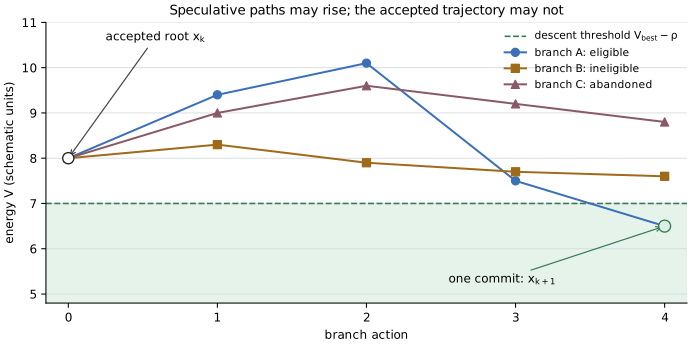
A schematic search round. Branch energy may rise inside a private workspace. Only the selected descent enters the accepted trajectory. The numbers are illustrative and are not evaluation results.
Definition 4 (Prompt sections, route resolution, and programs)
A prompt route is r = (a, f, m). Here a is the transport
adapter, f is the model family, and m is an optional exact
model. A stage s declares an ordered section list
Sec(s) = (c1, …, cj). Each section is a typed unit
with an identity, a version, a content hash, a declared variable schema, a
required flag, and a priority. Resolution operates per section:
The cases apply in order; the first matching case selects the section, so
R is a function. Every section has a base form: the build of the
owning crate fails if a declared stage lacks any base section, so R
is total for built-in stages. A model family outside the supported set,
including ModelFamily::Other, receives the base sections, never a route
error. A compiled domain package that declares a new stage must supply every
base section for that stage or its build fails closed. Replacement bundles
may be partial because they can only replace known section ids. Overrides are
inactive until Gate AE activates them.
Let the active section sequence preserve the order declared by the stage:
A compiled program is
where da, f, m is the resolved model dialect, Pc are the typed inclusion predicates evaluated on typed session state σ, v the canonical variable values, and βtok the prompt token budget. The size function is the dialect’s versioned exact tokenizer or a conservative upper bound; an underestimating accountant is not valid. Budget fitting is deterministic: optional sections are dropped in increasing priority order (ties broken by section id) until the size estimate fits βtok; required sections are never dropped; if the required sections alone exceed βtok, compilation fails closed. The dropped-section set is therefore a function of the inputs and is recorded.
Compilation is deterministic: identical (dialect id and version, ordered resolved sections with ids, versions, and hashes, inclusion outcomes, canonical variable values, token budget) yield identical rendered bytes, an identical dropped-section set, and identical digests.
Definition 5 (Search budget)
A search budget has an action limit Amax. It also has limits for model turns, tool calls, mutations, verifier runs, tokens, result bytes, elapsed time, and cumulative eager-copy files and bytes. Every branch action reserves resources before it starts. It also uses one action unit. Unused resource reservations may be released. An action unit is never returned. Usage is monotone. The forest cannot run more than Amax actions.
Definition 6 (Resident context)
For one model route, let βwin be the context-window limit under a versioned token accountant. Reserve βout for output, βtool for tool schemas and transport framing, and βguard for accounting error. The input allowance is
Let It be the compiled instruction program. Let Mt be the dependency closure of mandatory context pages. These include the task contract, control frame, current branch witness, current correction evidence, unresolved tool-call/result pairs, and every page required by an active capability or output contract. Let Ot be the optional working set. The resident context is
where c is the route’s deterministic token accounting function.
Every page is immutable and content-addressed. Select is deterministic.
If c(It) + c(Mt) > βin, the runtime makes no model call
and records ContextBudgetInfeasible. The composed request must also fit
the dialect’s independent byte limit. Failure of either bound stops before
transport.
Assumption 1 (Effect mediation)
Every branch effect passes the five-clause admissibility kernel. The branch capability is attenuated from the session grant. Promotion authority is withheld.
Assumption 2 (Sensor identity)
A sensor fingerprint includes tool identity, version, and configuration. A deterministic sensor returns the same result for the same realized state. Nondeterministic sensors must be declared. Replay uses their recorded result. It does not run them again.
Results
Proposition 1 (Gate decision conservation)
A forest rooted at one accepted state commits at most one candidate. A commit appends exactly one decision to D. Branch previews append no decisions. Therefore the Paper II bound remains
Argument. A preview calls the pure gate evaluator. It does not call the
trajectory commit method. The selected candidate causes at most one call to
submit_with_floor. That method appends one GateDecisionRef. Accepted
descents lower energy by at least ρ. There can be at most
⌊V0 ⁄ ρ⌋ such descents while energy remains
nonnegative. There can be at most B rejected commits. The final term
allows one terminal decision. Search adds no other term.
Proposition 2 (Accepted projection invariance)
Let S contain the search-only events. The accepted fold retains only ordinary trajectory events and keeps their relative order. Then
Argument. The accepted fold reads ordinary candidate_measured and
gate_decision_recorded events. It ignores search-only events. A discarded
branch emits no ordinary trajectory event. The selected candidate emits an
ordinary measurement and decision at commit time. Candidate identity keys the
two events. Removing search-only events does not change the fold.
This proposition concerns the accepted projection. It does not concern the full ledger root. Removing any ledger event changes that root.
Proposition 3 (Bounded search termination)
Every search forest closes after finitely many actions. In particular,
Argument. Every action uses one nonrefundable action unit. The forest has
at most nmax branches. Each branch has at most
Tmax actions. Either bound is sufficient. A deadline or another
resource limit may stop the forest earlier. The forest then records
search_closed and cannot reopen.
Proposition 4 (Replay of prompts and search)
Suppose a session pins its prompt bundles by content hash. Suppose every model call records the compiled program digest, ordered resident context page hashes, context digest, and raw transport observation. Then replay of one ledger prefix reconstructs the same accepted projection, branch state, budget usage, and Perspt-authored prompt messages. It makes no model call.
Argument. Each ledger event has one fold rule. Search usage increases by recorded amounts. Conversation deltas are digest chained. A prompt call names its dialect, its ordered section identities, versions, and hashes, its variable values, its dropped-section set, and its rendered digest. By Definition 4 compilation is deterministic in exactly these inputs, so the replayer either reconstructs the same program or reports a mismatch. It reconstructs the page sequence by Definition 6, reads model output from the ledger, and never samples the model again.
Proposition 5 (Deterministic selection)
Selection compares these keys in order:
hard pass before measured descent;
lower normalized energy;
greater improvement in the targeted residual cluster;
lower recorded cost; and
lexicographically smaller
branch_id.
The last key breaks every tie because branch identifiers are unique. The rule therefore selects one candidate from any finite nonempty eligible set. No model confidence or vote appears in the rule.
All candidates compared by keys 2 and 3 must use the same immutable energy and sensor profile. A profile mismatch makes a candidate ineligible for that comparison. It is not normalized after the fact.
Proposition 6 (Bounded and replayable context)
Every model request satisfies
It also satisfies the dialect’s declared request-byte limit.
If the ledger records the accountant identity, ordered resident page hashes, instruction-program digest, mandatory closure, and selection result, replay reconstructs the same Perspt-authored request bytes without consulting the model or rerunning a summarizer.
Argument. Definition 6 refuses an infeasible mandatory set. Otherwise,
Select receives only the remaining nonnegative allowance and cannot
exceed it. Pages and instruction programs are addressed by their canonical
bytes. Their order and selection inputs are ledgered. Reconstruction either
produces the recorded digest or fails closed.
Non-Claims
This PSP does not make the following claims.
Search does not prove that an eligible candidate exists.
Model-family diversity is not an independence certificate.
Internal branch states have no safety or progress status.
Coding realizability remains
not_claimed.Energy is only as meaningful as its sensor profile and calibration.
A prompt cannot grant authority. Rust types remain authoritative for schemas, effects, risks, footprints, and capabilities.
Replay covers Perspt state and Perspt-authored request content. It does not reveal hidden remote instructions or remote internal state.
The context selector optimizes declared obligation coverage. It does not prove that the selected pages are sufficient for task success.
Counterexample guidance is complete only when the domain supplies a sound and complete verifier over a declared hypothesis space. Coding diagnostics and finite test suites do not generally meet that condition.
Proposed Changes
Where This Lands
The numbering continues from system 18 in PSP 000009. This PSP defines systems 19 through 28.
The crate boundary is simple. perspt-sdk defines reusable primitives.
perspt-core owns the platform prompt section library and the model
driver. Domain crates own domain sections and verifier adapters.
perspt-agent is
the composition root. It runs actors, search, and integration.
This placement matches the current manifests. perspt-core already depends
on perspt-sdk. No dependency inversion is required.
![digraph ownership {
graph [rankdir=BT, bgcolor="#FFFFFF", pad="0.20",
nodesep="0.38", ranksep="0.55", fontname="Helvetica"];
node [shape=box, style="rounded,filled", fillcolor="#F7F8FA",
color="#637083", fontcolor="#1F2933", fontname="Helvetica", fontsize=10,
margin="0.14,0.09"];
edge [color="#637083", fontcolor="#1F2933", arrowsize=0.75, penwidth=1.1];
sdk [label="perspt-sdk\nprompt and search primitives"];
core [label="perspt-core\nplatform prompts\nmodel driver"];
coding [label="perspt-coding\ndomain prompts\ndiagnostic adapters"];
research [label="perspt-research\ndomain base sections"];
agent [label="perspt-agent\nactor turns, search, integration",
fillcolor="#EAF2FF", color="#3B6FB6", penwidth=1.4];
core -> sdk;
coding -> sdk;
research -> sdk;
agent -> core;
agent -> coding;
agent -> research;
agent -> sdk;
}](_images/graphviz-cc6af6bf23adfed1da40aa956eb6a4aaf8a2478f.png)
Ownership and dependency direction for PSP-10.
This release runs at most three branches. It runs one branch at a time. The
session store has one writer. Promotion holds one GraphWrite lease.
CandidateWorkspace uses a complete eager copy. Reflinks, sparse copies,
overlayfs, and other copy-on-write mechanisms are not permitted.
Before a fork, the runtime measures the accepted checkpoint without following symlinks. It reserves the file count and byte count against the forest budget. The copy must finish and its content root must match the checkpoint before the branch receives a model turn or tool capability. A failed or over-budget copy creates no branch. This rule gives every supported platform the same isolation and witness semantics. Branch concurrency is therefore one for this PSP.
19. Search Forest and Branch Lifecycle
Owner: perspt-sdk::search (types, selection);
perspt-agent::runtime::search (execution).
pub struct SearchForest {
    pub forest_id: String,
    pub task_id: String,
    pub node_id: String,
    pub generation: u32,
    pub accepted_root: String,      // state root of x_k
    pub branches: Vec<SearchBranch>,
    pub limits: SearchLimits,
    pub usage: SearchUsage,
}

pub struct SearchBranch {
    pub branch_id: String,
    pub parent_branch: Option<String>,
    pub accepted_ancestor: String,  // must equal forest.accepted_root
    pub seed_checkpoint: String,    // accepted root or parent's partial root
    pub seed_witness: WitnessRef,   // seed descends from accepted ancestor
    pub strategy: SearchStrategy,
    pub route: ModelId,
    pub prompt_program: PromptProgramDigest,
    pub state: SearchBranchState,
    pub usage: SearchUsage,
}

pub enum SearchBranchState {
    Ready,
    Running,
    PartialCheckpointed(PartialCheckpointRef),
    CandidateMeasured(BranchMeasurement),
    Selected,
    Rejected { reason: String },
    Abandoned { reason: String },
    Contained { certificate_id: String },
}

pub struct PartialCheckpointRef {
    pub state_root: String,
    pub accepted_ancestor: String,
    pub parent_witness: WitnessRef,
    pub correction: Option<CorrectionPacketRef>,
    pub remaining_obligations: Vec<ObligationRef>,
    pub evidence_digest: String,
}
AcceptedTrajectory remains the sole owner of accepted state.
SearchForest cannot mutate it. Search uses the pure gate evaluator for
previews. After selection, the runtime submits one candidate through the
ordinary trajectory method.
![digraph branch_lifecycle {
graph [rankdir=TB, bgcolor="#FFFFFF", pad="0.20",
nodesep="0.35", ranksep="0.50", fontname="Helvetica"];
node [shape=box, style="rounded,filled", fillcolor="#F7F8FA",
color="#637083", fontcolor="#1F2933", fontname="Helvetica", fontsize=9.5,
margin="0.13,0.08"];
edge [color="#637083", fontcolor="#1F2933", fontname="Helvetica", fontsize=8.5,
arrowsize=0.72, penwidth=1.05];
ready [label="Ready"];
running [label="Running\n(uphill steps allowed)", fillcolor="#FFF8E6"];
partial [label="Partial checkpoint\nprivate; not accepted",
fillcolor="#FFF8E6"];
child [label="Child ready\nwitnessed partial seed"];
measured [label="Measured\n(pure gate preview)"];
selected [label="Selected", fillcolor="#EAF2FF", color="#3B6FB6"];
committed [label="Committed x(k+1)", shape=box, peripheries=2,
style="rounded,filled", fillcolor="#E9F7EF", color="#347A55"];
abandoned [label="Abandoned"];
contained [label="Contained"];
discarded [label="Discarded\nworkspace removed",
style="rounded,dashed,filled", fillcolor="#F7F8FA"];
{rank=same; measured; abandoned; contained;}
ready -> running [label="fork accepted root"];
running -> running [label="mediated edit or probe"];
running -> partial [label="actionable evidence"];
partial -> running [label="continue next quantum"];
partial -> child [label="fork with witness"];
child -> running [label="next frontier epoch"];
running -> measured [label="realize; run required sensors"];
running -> abandoned [label="limit or false assumption"];
running -> contained [label="barrier or transport failure"];
measured -> selected [label="wins total order"];
measured -> discarded [label="ineligible or not selected"];
selected -> committed [label="one authoritative gate commit"];
abandoned -> discarded;
contained -> discarded;
}](_images/graphviz-b91243b98364a1325a67e3ba21528f6ccc1e5fcb.png)
A branch may fail freely. Only one selected candidate reaches the gate.
Each branch:
receives an isolated workspace seeded from the accepted checkpoint or a witnessed partial checkpoint whose accepted ancestor is that checkpoint;
receives a capability attenuated from the session grant with promotion and
UpdateGraphwithheld (the existingWITHHELD_EFFECTS+GrantPolicy::mintpath);holds an independent model-neutral conversation projection (
LoopContext), digest-chained into the ledger like any worker context;may perform bounded edits and verifier probes that create no gate decision;
produces a
BranchMeasurementonly after every required stage runs; andloses its private workspace when it is abandoned or not selected.
Continuing a partial solution
A verifier result need not divide the world into success and waste. If a
realized branch state is not eligible but has actionable structured evidence,
the runtime may persist it as a private PartialCheckpointRef. The next
search quantum may continue that state. It may instead fork one child from it
with a different correction operator, strategy, or route. The child inherits
the witness chain and the exact evidence. It does not inherit the parent’s raw
conversation.
A search quantum contains at most one model turn and its bounded governed tool actions. It ends at a verifier observation, a partial checkpoint, or a terminal branch state. Live frontier entries are served in epochs. Each entry receives at most one quantum per epoch. Within an epoch, the scheduler orders entries by the following deterministic key:
no operational barrier before a barrier;
fewer unresolved required obligations;
lower dominant residual magnitude under the common sensor profile;
lower cumulative recorded cost;
shallower checkpoint depth; and
lexicographically smaller
branch_id.
New entries join the next epoch. This rule prevents a promising branch from monopolizing the finite budget. The key is a scheduling heuristic. It is not an energy function, an acceptance rule, or a safety certificate.
When a verifier supplies a concrete failing input, test, or trace, the next
CorrectionPacket includes it as a counterexample. A compiler or language
server diagnostic that lacks such a witness is recorded as correction
evidence. Perspt uses the same correction loop for both, but it preserves the
distinction in the type and ledger event.
Proposition 5 defines selection. The rule uses verifier measurements and recorded costs. It does not use a vote or model confidence.
20. Adaptive Expansion and the Search Budget
Owner: perspt-sdk::search for policy types and
perspt-agent::runtime::search for triggers.
This system replaces the ensemble draw at the Refine rung. It does not change the Retry, Fallback, Refine, and Escalate ladder.
The first branch uses the primary actuator route with the domain’s default strategy. A partial checkpoint is continued before a fresh branch is opened when it has a nonempty correction packet and remaining local budget. Additional, deliberately diverse branches are opened only on a measured trigger:
an ineligible branch measurement or a
RejectedNonDescendingcommit;the same dominant residual cluster recurring without a changed correction route;
an empty
CorrectionPacket;a measured energy plateau across the branch’s probes;
a failed strategy-specific assumption (declared by the strategy, checked deterministically); or
the branch exhausting its local retry allocation while the shared search budget remains.
The release starts with one branch. It allows at most three branch identities, including children of partial checkpoints. It runs one quantum at a time. Expansion prefers a new correction operator, then a new strategy, then a new model family. This is a search heuristic, not a certificate.
pub struct SearchLimits {
    pub actions: u32,
    pub model_turns: u32,
    pub tool_calls: u32,
    pub mutations: u32,
    pub verifier_runs: u32,
    pub tokens: u64,
    pub elapsed_secs: u64,
    pub result_bytes: u64,
    pub workspace_files: u64,
    pub workspace_bytes: u64,
}
The forest owns one set of limits and one monotone usage record. An action
reserves resources before it starts. It always consumes one action unit.
Unused token or byte reservations may be released. Consumed usage never
decreases. workspace_files and workspace_bytes count cumulative eager
copy reservations. They are checked before each fork. A copy that exceeds its
reservation is aborted and contained.
Gate use is read from trajectory.gate_decisions.len(). Previewing a
branch does not change that length. Committing the selected candidate changes
it by one. The runtime refuses decision
Ngate + 1.
Duplicate suppression. An attempt whose exact Kng matches a recorded no-good, or a candidate whose realized state root equals an already measured root, is not re-executed. The forest records the refusal and moves to the next trigger or closes.
21. Search Evidence, No-Goods, and the Re-Keyed Accepted Fold
Owner: perspt-agent::toolloop (events); perspt-sdk::ledger
(fold).
Failed paths should remain useful without entering accepted state. Search
events use typed LoopEvent values. They retain the existing
Custom { kind: "tool_loop" } ledger encoding. New rows wrap the event in
one versioned payload:
pub struct LoopEventEnvelopeV1 {
    pub schema_version: u16, // exactly 1
    pub body: LoopEvent,
}
The SDK LedgerEvent alphabet records reusable mechanism events. The
runtime LoopEvent alphabet records actor, tool-loop, search, and prompt
events. These are distinct layers. A runtime fact is written once, inside the
tool_loop envelope. It is never mirrored into a nominally similar
LedgerEvent variant.
Rows without schema_version use the strict pre-PSP-10 decoder. Version 1
rows use LoopEventEnvelopeV1. An unknown version may be displayed as raw
forensic data, but authoritative replay and resume fail closed on it.
search_opened            branch_forked          branch_strategy_selected
branch_observation       branch_candidate_measured
partial_checkpointed     frontier_epoch_started frontier_entry_served
branch_ineligible        branch_not_selected    branch_abandoned
branch_selected          branch_committed       no_good_recorded
search_closed
context_working_set      context_pages_selected context_miss
context_page_recalled    context_infeasible      context_compacted
Every search event carries forest_id and branch_id. A measurement also
carries candidate_id.
A no-good must have deterministic support. Valid support includes a compiler error code, failed test identity, contract diagnostic, unchanged state hash, or denied capability. Model interpretation is only an observation. It cannot enter the no-good store.
A no-good suppresses only an exact repeated attempt. Its lookup key is
where r is the accepted root, d is the domain-manifest digest, s is the strategy digest, q is the prompt-program digest, p is the canonical proposal digest, c is the capability-grant digest, t is the effective tool-catalog digest, v is the required-sensor fingerprint, and b is the runtime-build digest. The record stores the supporting evidence hash separately. A lookup matches only when every key component is equal. Any changed root, prompt, proposal, grant, catalog, domain, strategy, sensor, or runtime build permits a new attempt.
No path prefix, operator class, residual class, model interpretation, or natural-language similarity may create or match a no-good. Candidate-root deduplication remains a separate exact hash check. This PSP does not implement generalized no-goods.
Cross-branch context is bounded. A branch may receive a
SearchEvidenceDigest. The digest contains residual clusters, no-good
references, and tried strategy identities. It never contains another branch’s
raw conversation.
The re-keyed fold. replay_accepted_trajectory currently keys
candidate energies by (node_id, generation); several candidates at one
key overwrite one another, so the accepted projection of an ensemble ledger
is already wrong today and a forest would make it worse. This PSP:
adds
candidate_idtocandidate_measured,gate_decision_recorded, anddurable_candidate_checkpointpayloads (serde-defaulted so pre-PSP-10 ledgers still fold);ledgers the full
GateDecisionRef.observed_energyandbest_accepted_beforeare recorded, not recovered by correlation; andre-keys the fold by
(node_id, generation, candidate_id).
With this key, Proposition 2 requires
holds and is enforced as a property test over every search mechanism-check ledger (Gate W).
22. Graph Staging and the Global Integration Gate
Owner: perspt-agent::runtime::integrate (new);
perspt-agent::runtime::dispatch (changed).
Two nodes may pass separately and fail together. An interface may drift. A
dependency may conflict. A test may fail only on the combined state. Today
fold_completion promotes each node winner as it settles. This PSP adds a
staging layer.
![digraph staging {
graph [rankdir=TB, bgcolor="#FFFFFF", pad="0.20",
nodesep="0.30", ranksep="0.48", fontname="Helvetica"];
node [shape=box, style="rounded,filled", fillcolor="#F7F8FA",
color="#637083", fontcolor="#1F2933", fontname="Helvetica", fontsize=9.5,
margin="0.13,0.08"];
edge [color="#637083", fontcolor="#1F2933", fontname="Helvetica", fontsize=8.5,
arrowsize=0.72, penwidth=1.05];
a [label="Node winner A"];
b [label="Node winner B"];
staging [label="Content-addressed\nstaging root", fillcolor="#EAF2FF"];
overlay [label="Integration overlay"];
gate [label="Full suite and\nconfigured test evidence", shape=diamond,
fillcolor="#FFF8E6"];
promote [label="Atomic promotion\nunder GraphWrite lease",
fillcolor="#E9F7EF", color="#347A55"];
restore [label="Restore prior root\nrecord conflict",
style="rounded,dashed,filled", fillcolor="#F7F8FA"];
{rank=same; a; b;}
{rank=same; promote; restore;}
a -> staging;
b -> staging;
staging -> overlay [label="deterministic merge"];
overlay -> gate [label="edge and interface checks"];
gate -> promote [label="hard pass"];
gate -> restore [label="fail"];
}](_images/graphviz-6dc11065df1c917057cb531d15dbf0be447fcff2.png)
Node winners are staged. Only a hard-passing integration root is promoted.
Node winners enter a content-addressed graph staging root. They do not enter the user workspace.
Dependent nodes fork their branch roots from the latest staging root, so downstream work builds on upstream winners without touching the user tree.
Disjoint concurrent winners merge deterministically into an integration overlay; typed interface/restriction checks run across graph edges.
One global verifier gate runs the full domain suite and the session’s configured test-evidence policy on the combined state.
Promotion requires a global hard pass. The runtime uses
certify_promotionandcommit_promotionunder oneGraphWritelease. Failure restores the prior staging root.
The work graph is the task trajectory. Branches propose node states. The staging root composes them. One atomic promotion commits the final result.
Test evidence is policy-bound rather than universally immutable. The default
evolving policy runs the resulting implementation, tests, and project
configuration, allowing an intentional contract change to replace obsolete
tests. backward-compatible adds a second view with recognized
pre-existing test files restored and is selected only when historical
behavior remains contractual. external-oracle overlays separately
protected acceptance material onto a private candidate copy and runs its
configured command as an additional required test stage. The same policy is
used by node gates, search previews, and the global integration gate, and its
identity is recorded in session_started. Benchmark hidden/ suites
remain withheld external evidence and are unaffected by the production
default.
23. Typed Prompt Sections and Codegen
Owner: the new perspt-sdk::prompt module (runtime types and
composition) and a new small build-dependency crate,
perspt-prompt-macros (compile-time codegen).
Prompt text is authored as small, single-concern markdown files. Each file
does one thing: state the role, explain the tool protocol, or define the
output contract. A stage prompt is their composition. A section opens
with typed front matter; the body is plain prose with {{variable}}
placeholders and nothing else. There is no template language: no
conditionals, no loops, no includes, no filters, no expression syntax. All
logic lives in typed Rust.
Section file anatomy
---
id: branch_correct/tool_protocol
version: 3
role: system
required: true          # never dropped by budget fitting
priority: 90            # higher survives longer (optional sections)
max_bytes: 4096
vars:
  tool_names: { type: "BoundedList<64,128>", style: bullet_list }
  budget_note: { type: "Option<BoundedText<512>>" }
---
Use only these tools:
{{tool_names}}
{{budget_note}}
Generated API
The build step parses every section at compile time and generates one typed struct per section in the owning crate:
// generated by perspt-prompt-macros; not hand-edited
pub struct ToolProtocol {
    pub tool_names: BoundedList<64, 128>,
    pub budget_note: Option<BoundedText<512>>,
}

impl PromptSection for ToolProtocol {
    const ID: &'static str = "branch_correct/tool_protocol";
    const VERSION: u32 = 3;
    const CONTENT_HASH: &'static str = "sha256:...";
    const REQUIRED: bool = true;
    const PRIORITY: u16 = 90;
    fn render(&self) -> RenderedSection { /* deterministic */ }
}
A malformed section fails cargo build of its owning crate. The codegen
validations are:
every
{{placeholder}}in the body is declared invars;every declared variable appears in the body (no orphans);
the declared Rust type is on the supported list below;
an optional or list placeholder is the only non-whitespace content on its line, because absence removes that line;
the static body (placeholders unexpanded) respects
max_bytes; the rendered bound — body plus every bounded variable’s declared worst case — is enforced at render time, which fails closed before any transport call;id,version,role, andrequired/priorityare present and well-formed; andthe stage’s section list is complete (every declared stage has all of its base sections).
Typed rendering rules
Template logic is replaced by deterministic typed rendering:
Declared type |
Rendering rule |
|---|---|
|
Locally trusted text, substituted after construction has enforced the byte bound. |
|
Untrusted text rendered in a canonical length-prefixed observation block. Delimiter bytes are escaped. The value never changes section structure. |
|
The line containing the placeholder is omitted entirely when the
value is |
|
Rendered in the declared |
integers / floats |
Canonical formatting (no locale, fixed float form). |
Unbounded String and Vec<String> are not supported section variables.
The distinction between trusted text and observations is explicit in the
generated Rust type. This prevents template-structure injection. It cannot
make untrusted prose semantically safe; capabilities and the admissibility
kernel remain the authority boundary.
This is the entire dynamic surface of a section body. Conditional structure
beyond a dropped line is expressed by the composer’s typed inclusion
predicates (system 24), never inside prose.
Issue-conditioned prompt plans
Perspt does not ask a model to write its next system prompt. It compiles an
IssuePromptPlan from typed state. A reviewed policy rule maps the actor
stage, residual class, available witness kind, correction operator, and
remaining budget to an ordered set of section ids. The mapping is ordinary
exhaustive Rust code and is tested like the stage composers.
pub struct IssuePromptPlan {
    pub rule_id: String,
    pub stage: PromptStage,
    pub issue: ResidualClass,
    pub witness: Option<CounterexampleRef>,
    pub correction: CorrectionPacketRef,
    pub sections: Vec<PromptSectionId>,
    pub context_request: ContextRequest,
}
The plan instantiates only compiled, active sections. It may select a compiler-explanation section for a type diagnostic, a failing-test section for a concrete test witness, or a hypothesis-revision section after the same residual recurs. The evidence values remain delimited data. They cannot add instructions, effects, tools, or capabilities.
This is a counterexample-guided architecture, not a claim that general coding is formal synthesis. If a sound verifier returns a concrete counterexample, the next plan must include it and the previous hypothesis in the correction contract. If the observation is only a diagnostic or finite-test failure, the plan calls it correction evidence and makes no completeness claim.
Research can propose a new policy rule, correction operator, or prompt section. It cannot become live prompt text at retrieval time. The proposal must cite a primary source, state the assumptions under which its result holds, pass license and prompt-injection review, compile into the finite section grammar, and enter as experimental content under Gate AE. A model may draft such an artifact, but cannot approve or activate it. Runtime prompt construction therefore remains dynamic over issue state and static over the reviewed instruction alphabet.
Runtime types
pub struct PromptSectionId(pub String);     // "stage/section"
pub struct PromptSectionVersion(pub u32);

pub enum PromptStage {
    // platform stages
    SessionBootstrap, GraphPlan, ToolDiscovery,
    ConversationCompact, ExternalReconcile,
    // domain stages
    RepositoryExplore, BranchStrategy, BranchPropose,
    BranchCorrect, BranchReview, Adjudicate, EvidenceSummarize,
}

pub struct PromptRoute {
    pub adapter: String,            // transport adapter identity
    pub family: ModelFamily,
    pub exact_model: Option<String>,
}

pub struct CompiledPromptMessage {
    pub role: PromptMessageRole,
    pub content: String,
    pub sections: Vec<SectionProvenance>, // id, version, content hash,
                                          // override origin
    pub rendered_hash: String,      // SHA-256 of rendered content
}

pub struct CompiledPromptProgram {
    pub route: PromptRoute,
    pub stage: PromptStage,
    pub dialect: DialectRef,        // id + version (system 24)
    pub messages: Vec<CompiledPromptMessage>,
    pub dropped_sections: Vec<PromptSectionId>, // budget fitting
    pub tool_spec_hash: String,
    pub program_digest: String,     // over canonical bytes of the above
}

pub struct CompiledPromptInvocation {
    pub platform: CompiledPromptProgram,
    pub domain: CompiledPromptProgram,
    pub invocation_digest: String,  // ordered platform + domain programs
}
Digests use a length-prefixed canonical encoding with the domain tag
perspt-prompt-v1, hashed with SHA-256 under the GrantPolicy
canonical-bytes discipline. Serde output is not treated as canonical.
Codegen pipeline
![digraph prompt_codegen {
graph [rankdir=LR, bgcolor="#FFFFFF", pad="0.20",
nodesep="0.35", ranksep="0.55", fontname="Helvetica"];
node [shape=box, style="rounded,filled", fillcolor="#F7F8FA",
color="#637083", fontcolor="#1F2933", fontname="Helvetica",
fontsize=9.5, margin="0.14,0.09"];
edge [color="#637083", fontcolor="#1F2933", fontname="Helvetica",
fontsize=8.5, arrowsize=0.72, penwidth=1.05];
md [label="section .md files\ntyped front matter",
fillcolor="#FFF8E6"];
gen [label="perspt-prompt-macros\nparse + validate\nat compile time"];
err [label="cargo build error", shape=octagon,
fillcolor="#FCEBEC", color="#A34A52"];
structs [label="typed Section structs\nconst content hashes",
fillcolor="#EAF2FF"];
composer [label="stage composer\npredicates + variables\n+ budget fitting"];
dialect [label="ModelDialect\nstructure per family"];
msgs [label="compiled messages\n+ digests", shape=box, peripheries=2,
style="rounded,filled", fillcolor="#E9F7EF", color="#347A55"];
md -> gen;
gen -> err [label="invalid"];
gen -> structs [label="valid"];
structs -> composer;
dialect -> composer;
composer -> msgs;
}](_images/graphviz-c15858a30128c18eab819bacfd72f4653d8b109e.png)
A bad prompt edit fails the build, never a session.
The owning crate’s test suite additionally snapshots every section’s rendered form with fixture variables, so a reviewed text change is always a visible snapshot diff.
24. Dialects, Composition, and Budget Fitting
Owner: perspt-sdk::model for the port; transport implementations for
the adapter identity; perspt-sdk::prompt for dialects and composition.
ModelTransport gains a stable adapter identity and a route method:
fn adapter_kind(&self) -> &'static str;

fn prompt_route(&self, model: &ModelId) -> PromptRoute {
    PromptRoute {
        adapter: self.adapter_kind().to_owned(),
        family: self.family_of(model),
        exact_model: Some(model.model.clone()),
    }
}
The configured endpoint id is not the adapter identity. A model served
through a compatible gateway keeps its own family identity. It must not
receive another family’s sections or dialect. Scripted transports use the
stable adapter identity scripted.
Section resolution
Each section resolves independently through the override chain of Definition 4. Base sections always exist, so resolution is total for built-in stages:
![digraph section_resolution {
graph [rankdir=TB, bgcolor="#FFFFFF", pad="0.20",
nodesep="0.30", ranksep="0.45", fontname="Helvetica"];
node [shape=box, style="rounded,filled", fillcolor="#F7F8FA",
color="#637083", fontcolor="#1F2933", fontname="Helvetica",
fontsize=9.5, margin="0.13,0.08"];
edge [color="#637083", fontcolor="#1F2933", fontname="Helvetica",
fontsize=8.5, arrowsize=0.72, penwidth=1.05];
route [label="adapter + family + model\n+ stage + section",
fillcolor="#EAF2FF"];
exact [label="Active exact-model\noverride file?"];
family [label="Active family\noverride file?"];
base [label="Base section\n(always present)", fillcolor="#FFF8E6"];
resolved [label="Resolved section", shape=box, peripheries=2,
style="rounded,filled", fillcolor="#E9F7EF",
color="#347A55"];
route -> exact;
exact -> resolved [label="yes"];
exact -> family [label="no"];
family -> resolved [label="yes"];
family -> base [label="no"];
base -> resolved;
}](_images/graphviz-89c623fafe9d11b908710508f48b627f1187f9c2.png)
Per-section resolution. Base sections make resolution total; overrides exist only with Gate AE activation evidence.
Model dialects
Structural differences between model families never fork prose. They live in one typed value per resolved route:
pub struct ModelDialect {
    pub id: String,                 // e.g. "native_multi_slot_v1"
    pub version: u32,
    pub system_slots: SystemSlotPolicy,   // Many | SingleConcatenated
    pub tool_calls: ToolCallConvention,   // Native | JsonInText
    pub reasoning: ReasoningTracePolicy,  // None | Requested | Stripped
    pub boundary_marker: String,    // delimiter for concatenated slots
    pub context_window_tokens: u64,
    pub max_output_tokens: u64,
    pub token_accountant: TokenAccountantRef,
    pub max_prompt_bytes: u64,
}
Two contrasting instances:
// A family with native tool calls and multiple system slots.
ModelDialect {
    id: "native_tools_v1".into(), version: 1,
    system_slots: SystemSlotPolicy::Many,
    tool_calls: ToolCallConvention::Native,
    reasoning: ReasoningTracePolicy::Stripped,
    boundary_marker: String::new(),
    context_window_tokens: 131_072,
    max_output_tokens: 16_384,
    token_accountant: TokenAccountantRef::for_route(),
    max_prompt_bytes: 262_144,
}

// A family reached through a single-system-slot endpoint that emits
// tool calls as JSON in text.
ModelDialect {
    id: "json_single_slot_v1".into(), version: 1,
    system_slots: SystemSlotPolicy::SingleConcatenated,
    tool_calls: ToolCallConvention::JsonInText,
    reasoning: ReasoningTracePolicy::None,
    boundary_marker: "\n===== perspt:boundary =====\n".into(),
    context_window_tokens: 65_536,
    max_output_tokens: 8_192,
    token_accountant: TokenAccountantRef::for_route(),
    max_prompt_bytes: 131_072,
}
The token accountant is versioned. It is either an exact tokenizer for the route or a conservative upper bound. Its identity and mode enter the program digest. The byte limit remains an independent transport bound.
The dialect decides how compiled messages are laid out (separate system messages or a deterministic concatenation with the boundary marker), whether the output contract section instructs native tool calls or a JSON envelope, and how reasoning traces are requested or removed before parsing. The dialect id and version enter the program digest.
Stage composition
A stage composer is ordinary typed Rust. It is the second dynamism channel after typed variables:
pub fn branch_correct(state: &TurnState) -> StageComposition {
    StageComposition::new(PromptStage::BranchCorrect)
        .section(Role { domain_id: state.domain_id.clone() })
        .section(ToolProtocol {
            tool_names: state.activated_tools(),
            budget_note: state.budget_note(),
        })
        .section_if(state.packet.is_some(), Correction {
            packet: state.packet.clone().unwrap(),
        })
        .section(OutputContract { dialect: state.dialect.tool_calls })
}
Inclusion predicates are code, so they are unit-tested like code; nothing conditional hides inside prose.
Budget fitting
Every section carries required or a priority. The composer fits the
dialect’s prompt budget deterministically: optional sections are dropped in
increasing priority order (ties by section id) until the estimate fits;
required sections are never dropped; required sections alone exceeding the
budget fail compilation closed. A worked example:
Section |
Required |
Priority |
Estimated tokens |
Fit at 1,800? |
|---|---|---|---|---|
|
yes |
n/a |
120 |
kept |
|
yes |
n/a |
640 |
kept |
|
yes |
n/a |
700 |
kept |
|
no |
40 |
460 |
dropped first |
|
no |
60 |
220 |
kept (fits after drop) |
|
yes |
n/a |
110 |
kept |
The dropped set (here {repository_hints}) is part of the compiled
program, enters the program digest, and is ledgered. Replay reproduces the
same drop or reports a mismatch.
Section fitting handles only the instruction program. It does not solve the larger problem of fitting conversation, evidence, source excerpts, and tool results. Those values use the resident-context mechanism below.
Bounded context as paged memory
The conversation projection is the backing store, not the prompt. It holds
immutable, content-addressed ContextPage values. A page names its kind,
source hashes, state dependency, byte and token costs, typed
obligations covered, freshness, and dependency pages. Tool calls and their
results form one atomic page. A lossy summary names every source page and is
never an authority record.
A state dependency is explicit. It is one of: session-invariant, accepted root, partial-checkpoint root, or path plus blob hash. The assembler checks the dependency against the current branch before making the page resident.
The resident set follows Definition 6. Its mandatory closure is pinned. The
optional candidate pool is a working set: pages referenced in the last
θ actor turns, pages named by the current residual cluster, and
pages explicitly requested by the current IssuePromptPlan. Older pages
remain in the backing store. A state change invalidates a page whose declared
dependency no longer matches; it does not silently rewrite it.
Optional evidence is represented by synopsis frames of at most q tokens. Each frame has a deterministically derived set of typed obligation labels. If the remaining allowance is R, then K = ⌊R ⁄ q⌋. With room for K frames, the selector maximizes the declared weighted coverage
This function is nonnegative, monotone, and submodular. Greedy selection by largest marginal gain, with page hash as the final tie-breaker, obtains a factor 1 − (1 − 1 ⁄ K)K ≥ 1 − 1 ⁄ e of the best declared coverage among the candidate frames when K > 0. The claim concerns the declared labels only. It does not say that a frame is relevant, true, or sufficient for success. Labels derived from model prose are not eligible; they come from typed task, path, symbol, diagnostic, test, capability, and provenance fields.
The frame size is an upper bound, so Kq fits the optional allowance. Unused space is allowed. Exact current evidence may be pinned in Mt; it need not be compressed into a synopsis. If mandatory evidence does not fit, Perspt fails before the model call. It never truncates a tool pair, witness, capability contract, or required prompt section.
Page faults and compaction
The model sees a small typed page index and may request context_recall by
page id, path, symbol, diagnostic id, test id, or provenance key. This is a
read-only governed tool. A miss records ContextMiss. A hit makes the
requested page a candidate for the next turn; it does not mutate the current
request. Page faults consume the ordinary tool-call, byte, turn, and elapsed
budgets, so repeated recall terminates with the forest.
Compaction writes a new summary page and retains the source pages in backing storage. The summary is an observation. Its claims carry source hashes, and the actor can fault the exact evidence back in. This resembles a small machine with a resident working set and a larger secondary store: locality is exploited, but eviction does not destroy information.
![digraph context_paging {
graph [rankdir=TB, bgcolor="#FFFFFF", pad="0.20",
nodesep="0.48", ranksep="0.48", fontname="Helvetica"];
node [shape=box, style="rounded,filled", fillcolor="#F7F8FA",
color="#637083", fontcolor="#1F2933", fontname="Helvetica",
fontsize=9.5, margin="0.14,0.09"];
edge [color="#637083", fontcolor="#1F2933", fontname="Helvetica",
fontsize=8.5, arrowsize=0.72, penwidth=1.05];
store [label="Content-addressed backing store\nexact pages + summaries"];
working [label="Typed working set\nrecent + issue-requested"];
mandatory [label="Mandatory closure\ncontracts, witness, tool pairs",
fillcolor="#FFF8E6"];
select [label="Deterministic coverage selector\nwithin remaining slots"];
resident [label="Resident turn context\nledgered page order",
fillcolor="#EAF2FF", color="#3B6FB6"];
call [label="Bounded model request", shape=box, peripheries=2,
style="rounded,filled", fillcolor="#E9F7EF", color="#347A55"];
recall [label="context_recall\nnext-turn page fault"];
{rank=same; working; mandatory;}
{rank=same; select; resident;}
store -> working;
store -> mandatory;
working -> select;
mandatory -> resident;
select -> resident;
resident -> call;
call -> recall [label="missing evidence"];
recall -> store [label="governed lookup", style=dashed,
constraint=false];
}](_images/graphviz-83002ecef4631ffd7e52979ebe29620bc8db7b7a.png)
The prompt is a bounded resident set over an immutable backing store.
Injected turn blocks
The third dynamism channel is the resident turn context. Correction packets, budget notices, no-good digests, graph deltas, and selected context pages are rendered as separate, delimited messages at turn boundaries. An invariant stage program is compiled once per dependency digest and reused while its route, manifest, catalog, capability, variables, and dialect remain unchanged. If a dependency changes, the program is recompiled and a new digest is ledgered. This gives a stable transport-visible prefix when state permits it; it does not pretend that one program is immutable for an entire session.
[perspt:turn-context v1]
dominant residual cluster: E0432 unresolved import (7 sites, 1 cluster)
correction targets: src/lib.rs, src/parser.rs :: parse_entry
remaining: 3 turns, 2 verifier runs, 41k tokens
no-goods: 2 recorded (exact-key)
[/perspt:turn-context]
![digraph turn_timeline {
graph [rankdir=LR, bgcolor="#FFFFFF", pad="0.20",
nodesep="0.35", ranksep="0.50", fontname="Helvetica"];
node [shape=box, style="rounded,filled", fillcolor="#F7F8FA",
color="#637083", fontcolor="#1F2933", fontname="Helvetica",
fontsize=9.5, margin="0.13,0.08"];
edge [color="#637083", fontcolor="#1F2933", fontname="Helvetica",
fontsize=8.5, arrowsize=0.72, penwidth=1.05];
program [label="compiled stage program\n(stable for dependency digest)",
fillcolor="#EAF2FF"];
t1 [label="turn 1\n+ turn-context block"];
t2 [label="turn 2\n+ correction block"];
t3 [label="turn 3\n+ budget notice"];
parse [label="fail-closed parse\nper output contract",
shape=box, peripheries=2, style="rounded,filled",
fillcolor="#E9F7EF", color="#347A55"];
program -> t1 -> t2 -> t3 -> parse;
}](_images/graphviz-d6c58caff2f2d108f15c4d3ae120474158c637e6.png)
An invariant stage program is reused; per-turn state arrives as resident context blocks.
Two programs per call
Each model call compiles two programs: the platform envelope and the domain stage. They remain separate messages with separate hashes. The dialect lays them out at the transport boundary:
![digraph prompt_composition {
graph [rankdir=TB, bgcolor="#FFFFFF", pad="0.20",
nodesep="0.42", ranksep="0.50", fontname="Helvetica"];
node [shape=box, style="rounded,filled", fillcolor="#F7F8FA",
color="#637083", fontcolor="#1F2933", fontname="Helvetica",
fontsize=9.5, margin="0.14,0.09"];
edge [color="#637083", fontcolor="#1F2933", arrowsize=0.72,
penwidth=1.05];
typed [label="Typed task, capability, tool,\nbranch, verifier, and budget data"];
platform [label="Platform section program\nperspt-core\nids + hashes",
fillcolor="#EAF2FF"];
domain [label="Domain section program\ndomain crate\nids + hashes",
fillcolor="#FFF8E6"];
dialect [label="ModelDialect\nslots, tool convention,\nreasoning, markers"];
adapter [label="Transport adapter\nordered messages"];
request [label="Model request", shape=box, peripheries=2,
style="rounded,filled", fillcolor="#E9F7EF", color="#347A55"];
typed -> platform;
typed -> domain;
platform -> adapter;
domain -> adapter;
dialect -> adapter;
adapter -> request;
}](_images/graphviz-3aed7eed57a572711c2520592d30bb73371ebafe.png)
Typed state feeds two section programs; the dialect controls the final message layout.
The domain program does not receive the platform prompt as a variable, and the platform program embeds no domain prose. Neither can reach data the type system does not hand it.
25. Section Ownership, Overrides, Manifests, and External Bundles
Owner: each section-owning crate; validation in perspt-sdk::prompt
and at build time in perspt-prompt-macros.
Sections live as markdown files in the owning crate, ordered by filename. There are no per-family directories and no copies: the base sections are the universal default for every model family, and a family variant is a single override file beside its base, never a forked directory. A fix to a base section reaches every family automatically.
crates/perspt-core/prompts/                  # platform sections
  manifest.toml                              # CLI-generated, committed
  session_bootstrap/
    10_role.md
    20_governance.md
    30_tool_discovery.md
  graph_plan/
    10_role.md
    20_update_protocol.md
    20_update_protocol.family_a.md           # family override (Gate AE)
  ...

crates/perspt-coding/prompts/                # coding domain sections
  manifest.toml
  branch_correct/
    10_role.md
    20_tool_protocol.md
    30_correction.md
    40_output_contract.md
  ...
The platform library owns: session bootstrap and platform behavior;
capability and permission explanation; the governed graph-update protocol;
tool discovery; external-effect reconciliation; the conversation-compaction
narrative; universal actor lifecycle and write-ahead behavior. The coding
library owns: repository exploration; search-strategy generation; branch
proposal; compiler/test-directed correction; candidate review; coding
adjudication; failed-path evidence summarization. Other domains follow the
same contract. perspt-research ships base sections only. Any family or
exact-model override enters as experimental and must pass Gate AE before
activation.
The manifest.toml is generated explicitly by
perspt prompts manifest, committed, and validated by the build step. A
normal build never edits the source tree. Per section it records: id,
version, stage, role, variable
schema, required/priority, size limit, owner, rationale, review
date, content hash, and, for overrides, activation state and the bound
PromptChangeRecord digest. The manifest digest is part of session
provenance.
Override activation. The base sections are the active baseline. An
override file whose rendered text differs from its base starts as
experimental. It cannot become the default merely because it is
route-specific or preferred by a reviewer.
Activation requires a content-addressed PromptChangeRecord. The record
binds the base and override section identities, versions, and content
hashes, the baseline and candidate manifest digests, route, stage, benchmark
digest, task-order and resampling seeds, model revision, catalog digest,
budgets, declared metrics, confidence intervals, reviewer, and decision. The
paired evaluation must contain at least 30 tasks in the affected domain and
prompt-route stratum. Both arms use the same task inputs, model revision,
catalog, initial context, and limits. Confidence intervals use 10,000 paired
percentile-bootstrap resamples with the recorded seed.
The candidate activates only when all of the following hold:
it creates no new escaped hard-gate regression;
the lower endpoint of the paired 95 percent bootstrap interval for the hidden hard-pass difference is at least − ϵprompt, where ϵprompt is fixed before the evaluation; and
either that lower endpoint is greater than zero, or the upper endpoint for one predeclared normalized cost difference is less than zero.
A smaller sample may be used for development, but the override remains
experimental. It runs only with --allow-experimental-prompts. That flag,
the candidate digest, and the missing activation evidence are ledgered.
Built-in and external bundle sections follow the same rule. A platform
override still requires --allow-core-prompt-override as an additional
condition. Configuration may raise the 30-task floor or reduce
ϵprompt. It may not lower the floor or set
ϵprompt outside [0, 0.05]. Invalid values fail at
startup.
Tool descriptions. ToolEntry separates authority from presentation
while preserving every authority field
(effect, risk, schema, footprint, proposal_bindings,
durable, and origin):
pub struct ToolEntry {
    pub name: String,
    pub discovery_summary: String, // trusted text used by tool_search
    pub description_templates: Option<ToolDescriptionLibrary>,
    // ... every existing field unchanged ...
}
to_spec_for_route compiles the final ToolSpec.description. If no
description library exists, it uses the route-neutral description. MCP
descriptions remain untrusted variable values rendered inside a local
wrapper section. The current [untrusted MCP description] prefix becomes
a typed obligation. Model-facing text never changes catalog effects, risks,
or footprints.
External prompt bundles. Built-in sections are compiled into their owning crate. A runtime cannot generate new Rust types safely. Therefore an external bundle may replace only a known section id and must use exactly that section’s compiled variable schema, role, and stage. It cannot add a stage, variable, dialect, or inclusion predicate. A new prompt vocabulary requires a compiled domain package. Compatible replacement bundles use the same body syntax and manifest contract:
[prompts]
bundles = ["/path/to/domain-prompts"]
The runtime scanner validates replacement bodies at session start against the
owning compiled SectionSchema. It accepts only the known placeholder
sequence and the bounded rendering rules in system 23; it is not a template
engine. perspt prompts lint exposes the same validation. The runtime
copies validated bundles into the content-addressed artifact store. A
running session never rereads the source directory. Domain bundles may
replace compatible domain sections. Replacing
platform sections also requires --allow-core-prompt-override. The ledger
records this weaker governance mode. ControlFrame gains
prompt_invocation_digest, prompt_manifest_digest, and
resident_context_digest.
These fields have serde defaults. An empty value marks an older checkpoint.
A nonempty value requires exact reconstruction from built-ins or stored
artifacts.
26. Structured Verifier Plane and Correction Packets
Owner: perspt-coding::diag (new); perspt-sdk::residual
(packet type); perspt-agent::candidate (wiring).
Language adapters preserve as much source structure as each tool provides.
Rust:
cargoandrustcJSON messages (--message-format=json): codes, spans, children, applicable suggestions.Python: the primary language-server sensor is
uvx ty server. Perspt preserves its LSP diagnostics. When the asynchronous LSP observation is empty, the current runtime checks withuvx ty checkand parses its versioned text format; this PSP does not claim a JSON format forty. Pyright is a declared fallback only whentyis unavailable. Pytest JUnit XML preserves test identity.TypeScript: a versioned parser normalizes
tsc --pretty falseoutput. The PSP does not claim thattscprovides a JSON diagnostic protocol.
The current perspt-coding::lang::PythonAdapter hard-codes a Pyright
SensorRef even when the plugin selected ty. Phase 6 removes that
split-brain identity. The adapter receives the effective sensor configuration
from the Python plugin and records the exact path used for each observation.
Sensor version and configuration fingerprints are preserved in
SensorRef (Assumption 2). A fallback emits SensorFallback and uses a
different sensor fingerprint. Measurements from ty and Pyright are never
pooled as one calibration stratum or compared as if they were the same
sensor. EvidencePayload::raw and ::structured
carry the actual
diagnostic evidence. Cascaded errors are clustered by root cause before
scoring, and magnitude is normalized per immutable sensor profile instead of
the current unconditional score = 1.0. Two hundred cascade errors from
one missing import are one cluster, not two hundred units of energy.
The two correction systems become one. The domain-level four-arm
correction_for delegates to the per-language
LanguageAdapter::correction_for (currently dead code), and all resulting
directions fold into a single coherent packet:
pub struct CorrectionPacket {
    pub dominant_cluster: ResidualClusterRef,
    pub diagnostics: Vec<StructuredDiagnosticRef>,
    pub affected: AffectedSet,        // paths, symbols, spans,
                                      // tests, graph edges
    pub operators: Vec<CorrectionOperator>,
    pub expected_footprint: FootprintSpec,
    pub follow_up_stages: Vec<String>,
    pub no_goods: Vec<NoGoodRef>,
    pub uncertainty: Vec<MissingSensorDecl>,
}
AgentDomainPackage gains defaulted, object-safe methods so both existing
domains compile unchanged until they opt in:
fn prompt_library(&self) -> &dyn DomainPromptLibrary;
fn search_strategies(&self, context: &SearchContext) -> Vec<SearchStrategy>;
fn correction_packet(&self, residuals: &[ResidualEvent])
    -> Option<CorrectionPacket>;
fn compare_branch_measurements(&self, root: &DomainMeasurement,
    candidates: &[BranchMeasurement]) -> BranchSelection;
push_correction renders the packet through BranchCorrect. It preserves
paths, symbols, and rationale. An empty packet causes expansion or escalation.
It never causes a generic blind retry.
The Paper II gate does not change. HardGatePolicy defines the required
stages used to compute hard_pass. If a required stage did not run, the
measurement records SensorUnavailable and sets hard_pass = false.
Barriers and required sensors are eligibility predicates. Targeted residual
improvement is a selection key. It is not a new acceptance rule.
Model-conditioned strategy statistics. Route-specific section programs encode different presentations of the same typed state, never different authority or acceptance rules. The store tracks
for route ordering, activated only past a minimum sample floor (the PSP-9 cold-start discipline: no prior masquerades as evidence). Route ordering is frozen within a branch. Model-family diversity remains a search prior, never an independence certificate. These online statistics may order already active routes. They never edit, approve, or activate a prompt section.
27. Universal Actor Turns and Kernel-Mediated Graph Update
Owner: perspt-agent::turn (new).
One ActorTurnRunner executes every stochastic actor: worker, explorer,
architect, adjudicator, evidence summarizer, capability probe, and any
external-tool-enabled actor:
resolve the model prompt route (system 24);
compile and ledger the platform and domain prompt programs;
call the transport, with the failover chain every actor now shares (today only the worker has one);
record the raw observation before any inspection as a typed
turn_observedevent with an actor tag, replacing the four ad-hocrecord_customJSON blobs that replay cannot reconstruct;parse deterministic output (fail-closed on schema mismatch);
convert tool calls or graph changes into governed proposals; and
record the result and the updated conversation projection.
Architect graph changes pass through the kernel. The runtime holds a
runtime-minted UpdateGraph capability. Workers never receive it.
WITHHELD_EFFECTS is unchanged. The architect’s update_graph
proposal runs check_full_admissibility like every other effect. A
kernel-refused revision falls back to the deterministic initial graph and is
ledgered. The inline hand-written JSON example in the architect prompt is
replaced by a variable rendered from the actual ToolSpec, so the schema
shown to the model cannot drift from the schema enforced on it.
28. Prompt and Search CLI, Observability
Owner: perspt-cli::commands::prompts (new); perspt-dashboard
(projection updates).
perspt prompts list                      # every section: id, version,
                                         # stage, overrides, state, hash
perspt prompts render <stage> --route ... # compose with fixture or
                                         # session variables; shows the
                                         # drop set for a token budget
perspt prompts diff <a> <b>              # rendered-output diff between
                                         # routes/versions/bundles
perspt prompts lint                      # the codegen checks, exposed
                                         # for external bundles
perspt prompts evaluate <candidate>       # paired run against its base;
                                         # writes PromptChangeRecord
perspt prompts activate <digest>          # requires passing evidence
perspt prompts explain-session <id>      # which programs a session
                                         # actually compiled, with digests
                                         # and dropped sections
perspt context explain-turn <session> <turn>
                                         # resident and evicted page hashes,
                                         # mandatory closure, coverage, cost
perspt status and the dashboard show opened, ineligible, unselected,
abandoned, selected, and committed branches. They also show remaining limits
and the no-good count. For each model turn they show the input allowance,
mandatory-page cost, optional frame count, page faults, dropped instruction
sections, and resident-context digest. The dashboard fold uses candidate
identity.
Conformance Gates
Lettering continues PSP 000009 (J-V). This PSP adds W-AF. Each gate names its falsifying predicate; the predicate runs in the mechanism checks.
Trajectory and provenance gates
Gate |
Requirement |
Falsifying predicate |
|---|---|---|
W |
Branch isolation. Ineligible, unselected, and abandoned branches leave the accepted workspace, the accepted fold, and the user workspace unchanged. |
A ledger where removing all search-alphabet events changes
|
X |
Gate decision conservation. Previews create no gate decisions. A forest commits at most one candidate. The enforced bound Ngate refuses further commits. |
A preview changes |
Y |
Prompt composition determinism. Each section resolves exact model, then family, then base; base sections are complete at build time; identical inputs (dialect, sections, variables, budget) yield identical rendered bytes, an identical drop set, and identical digests; an inactive override never resolves. |
Two compilations of one input set differing in |
Z |
Program provenance. Every model call ledgers its compiled
programs (dialect id and version, section ids, versions, and
content hashes, rendered hashes, dropped sections, program digest);
resume fails unless the exact program reconstructs from built-ins
or pinned bundle artifacts; platform override without
|
A model-call event with no program digest, a resume that proceeds past an unreconstructable digest, a replay whose drop set differs, or an unledgered platform override. |
AA |
Integration atomicity. Only the globally verified integration root is promoted, atomically; integration failure restores the prior staging root; partial promotion is impossible. |
Any user-workspace state containing one node winner but not the rest of its verified integration root. |
Search and activation gates
Gate |
Requirement |
Falsifying predicate |
|---|---|---|
AB |
Exact no-good soundness. |
A no-good whose supporting evidence is not a compiler code, test identity, contract diagnostic, state hash, or capability denial; a lookup that matches unequal key components; or a wildcard no-good. |
AC |
Search budget monotonicity. One limit set applies to each forest. Reservations, including eager-copy files and bytes, precede actions. Usage never decreases. A closed forest cannot reopen. |
An action without a reservation, decreasing action usage, usage above
a limit, an over-budget workspace copy, or an event after
|
AD |
Event-envelope singularity. Every new runtime event is written once
in a versioned |
A runtime fact written in two event alphabets, a version 1 row that does
not decode as |
AE |
Measured prompt activation. A section override is experimental
until a |
An override active with no passing record, a record not bound to the override’s section hash, fewer than 30 paired tasks, a margin above 0.05, a changed or unrecorded resampling procedure, a new escaped hard-gate regression, a failed confidence bound, or an unledgered experimental override. |
AF |
Resident-context boundedness. Every request fits Definition 6. Mandatory dependency closure is preserved, optional selection is deterministic, tool-call/result pairing is atomic, and replay uses the recorded page order without rerunning compaction. |
A request above its input allowance, a truncated mandatory page or tool pair, an optional page selected differently from identical inputs, a model-derived obligation label, a stale root-dependent page admitted, or replay that reruns a model or summarizer. |
Practical Decisions
The design makes the following tradeoffs.
At most three sequential eager-copy branches. This gives no parallel speedup. File and byte reservations bound copy cost. The rule avoids a second store writer, shared extents, and branch lease races.
Typed codegen instead of a template engine. Prompt text stays in human-editable markdown, but every section compiles to a typed struct and a malformed edit fails
cargo build. This costs a small build-dependency crate and slightly slower compiles. It removes the template-engine dependency and its control-flow injection surface. It does not solve semantic prompt injection from untrusted observations.No prompt database. Git reviews the text; the ledger already records which program (sections, versions, hashes, drop set) every call used. A registry would add a second source of truth and a bootstrap path for no new guarantee.
Base sections, not family copies. The five inline prompts move verbatim into base sections. No family directory ever starts as a copy; a family variant is one override file with Gate AE evidence. A base fix reaches every family; there is no copy drift to audit.
Two bounded memory planes. Optional instruction sections drop by stable priority. Optional evidence pages use weighted-coverage selection. Required instructions and mandatory evidence never compete silently. The split costs a page store and token accounting, but makes context loss explicit.
Partial checkpoints are private. Actionable partial work can seed a child branch through a witness chain. This costs storage and another search state, but avoids restarting every correction from the accepted root.
Runtime events use one versioned envelope. The envelope is
Custom { kind: "tool_loop" }. SDK mechanism events retain their own alphabet. One fact is never written to both.No-goods are exact. A repeated attempt is suppressed only by equality of every Kng component. This gives up speculative generalization in exchange for deterministic replay and local invalidation.
Prompt divergence is evidence-gated. Family-specific text remains experimental until a paired evaluation passes Gate AE.
The ensemble and exploration APIs are removed. This breaks old configuration. It leaves one search mechanism instead of three.
Rationale
Why use a forest instead of a wider ensemble? The PSP-9 ensemble changes only the model family. It runs only at the Refine rung. A failed attempt may instead need a new strategy, plan, or prompt program. The forest can vary each of these. It can also stop a weak branch early. Route diversity remains an expansion prior and must be tested by ablation.
Why retain partial checkpoints? A failed candidate can contain a correct substructure and one localized defect. Restarting from the accepted root throws that information away. Continuing every partial state forever is also wrong. A private checkpoint plus a finite frontier quantum retains measured work without confusing it with accepted progress.
Why require eager copies? Shared extents and platform-specific overlays make physical isolation and disk accounting harder to attest. Three sequential copies are slower, but their roots, costs, cleanup, and recovery are portable and directly testable.
Why keep no-goods exact? A generalized pattern can suppress a valid path after a small change in state, tools, prompts, sensors, or authority. Exact keys invalidate locally and replay without an inference rule.
Why keep two event layers? SDK mechanism events and runtime actor events serve different consumers. A versioned runtime envelope preserves that boundary. The single-write rule prevents competing histories.
Why require evidence for prompt divergence? Route-specific prose is a hypothesis about model behavior. The paired activation rule tests that hypothesis under equal budgets before it becomes a default.
Why sections and dialects instead of per-family prose forks? Some model interfaces differ structurally in system-slot layout, tool-call convention, and reasoning-trace handling. A typed dialect represents an enumerable difference as data; a forked paragraph hides it inside prose a reviewer must diff by eye. Forked copies also drift: a fix to one copy silently misses the others, and no gate catches unintentional divergence. One base section per concern, plus rare evidence-gated overrides, keeps every family on the reviewed text by construction.
Why typed codegen over a template engine? A template engine buys conditionals and loops at the price of a runtime failure mode and an injection surface inside every prompt. Perspt’s conditionals are typed inclusion predicates and its loops are typed list rendering, so the engine buys nothing the type system does not already provide. Compile-time codegen turns every malformed prompt edit into a build error and every text change into a snapshot diff, while the files stay as human-editable as the markdown files from which they are compiled.
Why no prompt database? Registry practice stores immutable prompt versions and traces which version served each request. Perspt already has both: git holds the reviewed, versioned text, and the ledger records the exact section set, hashes, and drop set of every model call. A database would add a second source of truth, a bootstrap path, and unreviewed runtime text for no guarantee the ledger does not already give.
Why use adapter and family as prompt identity? Endpoint ids name credentials and locations. Model families describe instruction-following behavior. A section program for one family sent to another family is a category error.
Why exclude model confidence? Model confidence is sampled and usually uncalibrated. Compiler and test measurements are external observations. Stochastic actors propose. Deterministic rules select and commit. Proposition 5 depends on this separation.
Why compile issue-specific prompts from evidence? A verifier can say more than pass or fail. A concrete counterexample rules out the current hypothesis; a structured diagnostic narrows the next correction. Typed policy rules can select the corresponding reviewed sections without letting retrieved prose or model output rewrite the control plane.
Why page context? Long conversations behave like an address space larger than a single request. Sending the whole history wastes capacity; replacing it with one opaque summary loses evidence. A pinned working set, immutable backing pages, and explicit faults preserve exact material while bounding each turn. The coverage theorem justifies one local selector objective. It does not claim an optimal prompt or an optimal agent.
Why keep empirical observations non-normative? Implementation experience can suggest experiments. It does not supply Perspt’s control law, authority model, or prompt text. Perspt tests each hypothesis against its own domains and conformance gates.
Why fix enforcement first? Search increases the number of proposals. It must not increase unchecked authority. The bound, hard-gate wiring, graph capability, and replay key therefore land before search.
Compatibility and Cutover
Removed without aliases (house precedent: PSP-9 removed the PSP-5 surfaces outright):
perspt_sdk::exploration:ExplorationBudget,ExplorationUsage,ExplorationReport,GraphHint(dead surface; the deterministic mapper survives, see below);perspt_sdk::model::ensemble:EnsemblePolicy,EnsembleTrigger;perspt_core::config::EnsembleConfigand the[ensemble]section; a config containing[ensemble]fails with a pointed migration error naming[exploration], never a silent ignore;perspt-agent::runtime::ensembleandresolve_ensemble_policy;the
--ensemble-widthCLI flag; themc_ensemble.rsfixture; the README ensemble rows;the dead prompt machinery:
Plugin::correction_prompt_fragment(three implementations),perspt_core::types::prompt(PSP-7 residue), and the never-calledadjudication_briefhook.
The deterministic repository mapper is moved, not removed. map_workspace
still runs at session open. Its ProjectMap moves into
perspt_sdk::search as the seed of SearchContext.
--exploration-only uses SearchLimits.tool_calls and
ActorTurnRunner.
No template-engine dependency is added: the prompt plane compiles to plain
Rust. The only new build-time dependency is the small
perspt-prompt-macros crate, owned in this workspace.
Added configuration:
[exploration]
initial_branches = 1        # release default
max_branches = 3
distinct_family = true      # expansion prior, not a certificate
max_workspace_files = 300000
max_workspace_bytes = 4294967296  # 4 GiB cumulative eager copies
# expansion triggers and budget table per system 20

[prompts]
bundles = []
activation_min_tasks = 30       # minimum allowed value
noninferiority_margin = 0.05    # allowed range: 0.0 through 0.05

[context]
working_set_turns = 6
synopsis_frame_tokens = 512
output_reserve_tokens = 16384
guard_reserve_tokens = 2048
The gate rule, admissibility kernel, recovery ladder, promotion path, and
outer ledger encoding do not change. The tool_loop payload becomes
versioned. Replay, resume, and audit gain new events but keep their existing
meaning. simple-chat does not construct the prompt library even though it
links perspt-core. It loads no forest, catalog, store, or external tool.
Ledger and checkpoint compatibility: every new event field
(candidate_id, forest_id, branch_id) and every new
ControlFrame field (prompt_invocation_digest,
prompt_manifest_digest, resident_context_digest) is serde-defaulted.
Pre-PSP-10 ledgers fold identically through the strict legacy payload decoder.
Pre-PSP-10 checkpoints
resume legacy-permissive. Post-PSP-10 checkpoints resume strictly (Gates Z and
AD). Unknown payload versions never resume.
Reference Implementation
Phases are independently landable and behavior-preserving until Phase 7 (the cutover). Every phase exits with the workspace tests, clippy, and the PSP code check green, without adding entries to the warning baseline.
Foundation phases
Phase |
Gates |
Content |
|---|---|---|
1 - Enforcement debts |
X |
Enforce the finite-decision bound in the tool loop (refuse the
Ngate + 1-th submission); wire
|
2 - Candidate identity |
W |
|
3 - SDK prompt sections and codegen |
Y, AF |
|
4 - Route and ToolEntry (behavior-preserving; |
Y |
|
5 - Platform section library |
Y, Z, AE |
|
6 - Domain prompts, packets, and verifier adapters |
Y |
|
Search and integration phases
Phase |
Gates |
Content |
|---|---|---|
7 - Search types and cutover (breaking) |
AC, AD |
|
8 - Adaptive branch execution |
W, X, AB, AC |
|
9 - ActorTurnRunner |
Z, AD, AF |
|
10 - Graph staging and integration gate |
AA |
Staging root in |
11 - CLI, bundles, conformance, and evaluation |
Z, AE, AF |
|
Test and Acceptance Plan
Search invariants (Phase 8): a branch may increase energy before it finds a descent. Ineligible, unselected, and abandoned branches leave accepted state unchanged. Every branch starts from the accepted root or a partial checkpoint with a complete witness chain to that root. Partial checkpoints never enter the accepted fold. Frontier epochs serve every live entry at most once before the next epoch. The action limit ends search. File and byte reservations precede every eager copy. Reflinks and copy-on-write mounts are rejected. Previews create no gate decision. A forest commits at most one candidate. Duplicate roots and exact Kng attempts are not re-executed; unequal keys are. An empty correction packet expands or escalates. Crash and resume reconstruct the forest, usage, prompt programs, and accepted root.
Resident context (Phases 3 and 9): randomized page sets never exceed the route’s declared input allowance. An infeasible mandatory closure makes no model call. Tool-call/result pairs remain atomic. Root-dependent pages are invalidated after an accepted-root or partial-checkpoint change. Path pages are invalidated when their blob hash changes. Greedy selection is deterministic and is checked against exhaustive optimum on small weighted-coverage fixtures. Page faults consume ordinary budgets. Replay reconstructs the same ordered page hashes and request digest without a model or summarizer call.
Prompt matrix (Phases 5-6): every family, including
ModelFamily::Other, composes every stage from base sections; an
activated exact-model override beats an activated family override beats the
base; an inactive override never resolves; a missing base section fails the
build for a compiled stage; a replacement bundle cannot add a stage or alter
its schema; undeclared, orphan, and unbounded
variables fail the build; composed rendering, drop sets, and hashes are
deterministic across dialects; the two contrasting dialects lay out the
same programs differently and both parse fail-closed against their output
contracts; prompt-visible tool names match the effective governed catalog;
bundles are pinned and replayable; platform override without the flag is
rejected, with the flag is ledgered; no production
Conversation::with_system literal remains outside the section
libraries, tests, probes, and examples.
Prompt activation (Phases 5 and 11): a divergent section override remains
experimental without 30 paired tasks and a content-addressed
PromptChangeRecord bound to its section hash. Fixtures falsify each
activation condition separately:
sample floor, escaped hard-gate regression, noninferiority, declared benefit,
configuration bounds, resampling seed and count, digest binding, and
experimental-override ledgering. Online route statistics cannot activate a
section.
Event replay (Phases 7 and 9): pre-PSP-10 payloads decode only through the
legacy decoder; version 1 payloads decode only through
LoopEventEnvelopeV1; unknown versions stop resume; and one runtime fact
never appears in both runtime and SDK event alphabets.
Verifier and graph behavior (Phases 6 and 10): normalized diagnostics preserve codes, spans, suggestions, test identities, and root-cause grouping; declared stages control hard pass; two node candidates passing independently but failing composed are rejected by the integration gate; disjoint winners merge deterministically; integration failure restores the prior staging root.
Evaluation (Phase 11): the Rust and Python suites use matched tasks. Each arm gets the same model, initial context, tools, token limit, and elapsed limit. The seven arms are:
the direct model harness;
Perspt with one branch and prompt programs;
the prior arm with correction packets;
the prior arm with resident-context paging;
the prior arm with adaptive search;
the prior arm with multi-family expansion; and
the prior arm with graph integration.
The primary outcome is hidden-test hard pass. Secondary outcomes are escaped regressions, elapsed time, token cost, tool cost, verifier cost, duplicate branches, correction effectiveness, mandatory-context failures, page-fault rate, exact-evidence recall, resident obligation coverage, recovery, and replay validity.
Task order is randomized. Every task keeps its paired arm results. Reports show paired differences and bootstrap confidence intervals. They also publish all timeouts and infrastructure failures. Energy remains diagnostic until its sensor normalization passes a separate calibration check.
Before evaluation, the release defines a noninferiority margin ϵ. Adaptive search becomes the default only if the lower bound of the confidence interval for
is at least − ϵ. It must also reduce repeated identical failures and produce no escaped hard-gate regression in the acceptance fixtures. Live runs must cover two model families. Scripted transports cover route invariants for a third family when credentials are unavailable.
Implementation Status
Three statuses are reported separately and never conflated:
SDK — the contract exists and is unit-tested.
Wired — the mechanism is invoked on the live runtime path, verified by scripted-transport mechanism checks.
Accepted — the live seven-arm evaluation demonstrated the claimed capability improvement with paired evidence.
Live seven-arm runs were recorded on 2026-08-19 across two model families
(reports under psp-000010/evidence/): komerco::qwen-3.8-27b
(llama.cpp) passed 35/35 hidden-test cells — every arm, every matched
Rust and Python task, zero denied and zero repeated calls, with the
governed arm’s mean wall time (25.0s) matching the ungoverned direct
arm’s (25.8s) — and vertex::gemini-3.5-flash-lite passed 30/35, with
all five failures being turn-1 provider-quota (429) infrastructure
failures published in the report, one of them in the direct arm. No
phase advances to Accepted on this evidence: the matched suite
saturates (nearly every arm passes), so noninferiority is demonstrated
(qwen paired CI for adaptive−single is exactly [0, 0]) but no per-phase
improvement is separable, and the spec’s adaptive-default rule
(“must also reduce repeated identical failures”) is not met when both
arms already show zero. The default stays initial_branches = 1.
Those 2026-08-19 reports are retained as historical harness evidence only. They predate the content-addressed 30-task corpus introduced on 2026-08-21, so their five-task corpus digest cannot be aggregated with the release corpus and they do not satisfy Gate AE’s sample floor. New live reports are required; Accepted remains unclaimed.
Note
Updated as each phase lands. This PSP ships within the v0.6.6 release line together with PSP-9.
Phase |
Gates |
Status |
Notes |
|---|---|---|---|
1 - Enforcement debts |
X |
SDK + Wired |
Decision bound enforced at the gate and loop layers; trajectory
identity carries real node/generation; |
2 - Candidate identity |
W |
SDK + Wired |
|
3 - SDK prompt sections and codegen |
Y, AF |
SDK + Wired |
|
4 - Route and ToolEntry |
Y |
SDK + Wired |
|
5 - Platform section library |
Y, Z, AE |
SDK + Wired |
Five literals migrated byte-identically ( |
6 - Domain prompts and verifiers |
Y |
SDK + Wired |
Structured diagnostics (cargo JSON, ty, Pyright, pytest JUnit,
tsc) with root-cause clustering; |
7 - Search types and cutover |
AC, AD |
SDK + Wired |
|
8 - Adaptive branch execution |
W, X, AB, AC |
SDK + Wired |
Preview/commit forest on the Refine rung ( |
9 - ActorTurnRunner |
Z, AD, AF |
SDK + Wired |
Six actors (worker, explorer, architect, adjudicator, summarizer,
capability probe) on one runner with shared failover, a hard
per-call wall-clock deadline ( |
10 - Graph staging |
AA |
SDK + Wired |
Content-addressed staging root, dependency-aware conflict
detection (siblings only; downstream refinements win by edge
precedence), predecessor-scoped inherited seeding, enforced
|
11 - CLI, bundles, and evaluation |
Z, AE, AF |
SDK + Wired |
|
Errata (2026-08-20)
An independent conformance audit of the first implementation confirmed several places where the wired code fell short of this specification’s own gates, and a small number of places where the specification’s text was internally in tension or under-specified. The code defects are fixed; the clarifications below tighten definitions without changing the design (per Design Closure, a design change would require a new PSP).
Resume invariant vs. Phase 8 note. “Crash and resume reconstruct the forest, usage, prompt programs, and accepted root” is satisfied by ledger fold: resume folds every
no_good_recordedrow back into the exact-key store and seeds the interrupted forest’s consumption from its lastsearch_usage_snapshot(limits are never silently refilled). The forest itself deterministically re-opens as a new forest linked to the interrupted one throughSearchOpened.resumed_from— it is never resurrected mid-epoch. Quantum granularity remains one full branch attempt.ControlFramecarries the node identity (node_id); an empty value marks a legacy checkpoint.Definition 5 action granularity. One action is one fork, one model turn (with its per-turn tool-call, mutation, and bounded result-byte allowances), or one verifier measurement. Every action reserves before it runs and settles with observed actuals; the fork’s eager-copy reservation is held for the forest’s lifetime. Elapsed time has no pre-action hook: it is charged at branch boundaries under the per-call deadline.
Gate AC overflow rule. When settled actuals cross a limit, usage is charged to the limit, the forest closes, and the overflow is ledgered as an observation — recorded usage never sits above a limit (the falsifying predicate is unreachable by construction, not merely detected after the fact).
Gate AB support eligibility. Evidence classes map from typed residual classes: test/regression/runtime failures support
failed-test; compiler-diagnostic classes supportcompiler-code(the structured tool code when the sensor preserved one, else a class-tagged content hash — never prose); contract-shaped classes supportcontract-diagnostic; policy/capability denials supportdenied-capability. Environmental classes (sensor unavailable, tool failure, provider unavailable, budget classes) and model interpretation cannot support a no-good — recording one would wrongly suppress a valid retry. The unchanged-state class carries the realized candidate state root, never a derived score.no_good_recordedadditionally carries itssupport_kindfor replay verification.Definition 6 covers the composed transport request. The input allowance bounds the request actually serialized to the wire: eviction tombstones and the transport-only page-index note are charged inside βin (each resident page costs its marginal over its own tombstone), and the dialect’s independent byte limit applies to the composed request. An over-allowance composed request is refitted by dropping optional pages or refused with
context_infeasible— it is never sent.Atomic tool pages. A multi-call batch message and all of its result messages form one atomic page: one page id, one residency decision, one recall.
Typed recall keys, v1.
context_recallresolves by page id or its 16-hex prefix, bypath(from typed tool-call arguments), and by tool/call/turn keys; the provenance key is the page’s content address.diagnostic_id/test_id/symbolarguments are declared and resolve only where a typed source field exists — symbol keys are deferred until one does. Evicted requests carry a bounded, transport- only page index (never part of the projection or the compiled program).Page provenance is birth state. A page’s declared dependency is the state it was created under (session-invariant for the instruction/task head, the accepted root at append time, the partial root under a continuing branch). Assembly validates that dependency against the live environment; a state change invalidates stale optional pages — it never relabels them.
System 22, dependent graphs. A downstream node’s seed is exactly its transitive predecessors’ staged contributions, restored as inherited (non-promotable) state so its export carries only its own work. Same-path divergence is a conflict only between topologically incomparable nodes; a downstream refinement of a predecessor’s file wins by edge precedence. A node’s declared
output_targetsare its enforced mutation-only write scope (reads stay workspace-wide); undeclared targets keep unrestricted writes under the opaque scheduler footprint.Withheld oracles. The evaluation’s hidden suites are genuinely withheld: oracle files live outside the fixture and are overlaid onto a fresh copy of the post-run tree at verification time, overwriting any visible test the agent may have weakened. Fixtures may contain weak smoke tests, never oracle content.
Lint is advisory at the hard gate.
HardGatePolicy’s required stages are the complete gating set (plusformatwhen the run declares it); residuals from non-required stages still enter the energy and correction packets but cannot block hard pass — a pre-existing repository warning cannot make hard pass unreachable.
A second audit round on the remediated implementation (same date) found residual gaps in the wired mechanisms; items 12–17 record how they close.
Gate AA across resume. An interrupted multi-node session never resumes into single-node direct promotion. Staged winners are persisted content-addressed at staging time; resume reconstructs the staging root by ledger fold, marks staged nodes stable, resets the rest to pending, and re-enters ordinary dispatch — the combined root reaches the user workspace only through a fresh run of the global integration gate. The interrupted node continues its durable mid-loop checkpoint only when it inherits nothing (a checkpoint cannot carry predecessors’ staged state); a dependent node re-runs deterministically atop its staging seed. Route state carries over; per-node loop budgets are the configured ones — a graph resume re-dispatches nodes as fresh attempts, while search usage and no-goods are still preserved by the ledger fold. A graph with a terminally failed node refuses resume (its staged winners were already discarded), and a staged contribution that predates durable staging refuses reconstruction — fail closed, never a partial promotion. The exact remaining-budget continuation of resolved decision 6 applies to single-node sessions.
The recency pin honors invalidation. Erratum 8’s invalidation admits no mandatory exemption: a pinned-tail page born under a superseded root is demoted to the invalidated pool (tombstoned, recallable) rather than kept resident. The instruction/task head is session-invariant and unresolved tool pairs exist only within the turn that opened them, so both stay pinned unconditionally. The assembler additionally refuses outright any mandatory page whose dependency fails — a stale root-dependent page cannot be admitted by any producer defect.
Usage snapshots at action granularity.
search_usage_snapshotis emitted after every reservation and every settlement (plus the epoch and branch boundaries), so the durable record is always the reserved worst case or the settled actuals. A crash inside a branch resumes with at least the reserved consumption — an interruption can over-charge, never refill.Exact no-good identity, tightened.
ddigests the domain manifest (residual schema, energy model, hard-gate policy, verifier suite) — not the bare domain id.cincludes the enforcedwrite_scopeand the capability’s graph-revision/node-generation binding.bcarries the build’s git commit, stamped by the build script (an externally suppliedPERSPT_GIT_SHAwins; a build without git falls back to the version-only identity). Clustered structured evidence (an array of diagnostics) contributes its sorted distinct codes as the evidence value.Pairwise conflicts over the full writer set. Erratum 9’s incomparability rule is evaluated over every unordered pair of same-path writers: a divergent write by two incomparable nodes conflicts even when a downstream refinement superseded one of them (
a → bwith siblingz:a:X,b:Y,z:Y still conflicts on the pair(a, z)).Infrastructure failures are stage-routed. Erratum 11 extends to verifier infrastructure: an unavailable capability, launch error, or timeout blocks hard pass only when its stage is required. A lint timeout or missing lint binary is as advisory as a lint finding — it is still reported (
SensorUnavailable) and, being environmental, never supports a no-good.
A third audit round found residual crash/resume gaps in genuinely concurrent paths; items 18–21 close them.
Checkpoints carry page provenance. The durable candidate checkpoint persists each message’s birth dependency parallel to the conversation, and a resumed loop restores those exact labels — never a wholesale relabel with the live root, which would launder stale pages as fresh (erratum 8’s falsifier) and turn the session-invariant head into a page the next acceptance stales, killing the continuation at the fail-closed assembler. A pre-provenance checkpoint restores with the legacy fallback: the instruction/task head is session-invariant, and every remaining page is deliberately stale/tombstoned because its true birth root is unknowable. It is never labelled with the restored root, which would launder unknown evidence as current.
The conversation refold routes by digest chain. Concurrent node loops (and search branches) interleave conversation events on the one session ledger, so the Gate O refold no longer holds a single live projection: it collects every seed and delta record, walks the checkpoint’s parent chain back to its seed, and replays that one chain forward through the sole writer — a parallel graph’s ledger is exactly as refoldable as a serial one. A broken chain still fails closed.
Resume judges the graph by its latest recorded state. Sibling terminality and staging reconstruction are evaluated against the last recorded descendant of the checkpoint’s graph revision, not the checkpoint-era snapshot — a sibling whose terminal fold landed in a later revision still refuses resume (erratum 12), and a resumed node’s mid-loop checkpoint continues only if the latest state shows it unchanged at its recorded generation.
Every reservation is durable and every refusal is free. The fork’s eager-copy reservation and the preview verifier reservation are snapshotted into the ledger before the copy or the sweep runs, so a crash in either window resumes with the charge. Fork admission checks the exact no-good store and the turn-headroom probe before reserving: a suppressed duplicate or refused fork consumes nothing.
A fourth audit round exercised durable-record ambiguity and parallel large-project paths; items 22–26 close those residuals.
The ledger is the checkpoint authority. Resume selects the last
durable_candidate_checkpointin verified ledger order, not the newest row of the auxiliary checkpoint table. The table may lag the event across a crash, tie on timestamps, or contain a later context checkpoint; none can hide or replace the hash-chained resume point. The event’s conversation, provenance, control frame, scope, and file handles are used directly. The conversation and activated-tool set must refold from their digest chain, the event state root must equal the control frame’s accepted root, and a non-empty provenance vector must be exactly parallel to the conversation; disagreement refuses resume.Graph resume requires one unambiguous lineage. Starting at the checkpoint revision, later graph revisions must form one contiguous parent/sequence chain. A fork from an earlier ancestor refuses resume rather than selecting whichever branch happened to be recorded last. A node’s mid-loop checkpoint is eligible only while the latest graph still marks that exact generation
Running; a later state fold or generation change causes a fresh governed attempt.Staged winners are generation-bound. Every
staging_root_updatedevent records the producing node generation. Reconstruction admits a contribution only for the latest graph’s same generation; a superseded generation is ignored and re-runs. Staging records predating this binding refuse reconstruction because assigning them to a replacement node would be ambiguous.Interrupted search usage has one owner.
SearchOpenedalready records node, generation, and accepted root; the resume fold carries that complete binding intoSearchSeedindependently of which parallel node wrote the latest candidate checkpoint. A different node, generation, or root may open a forest first, but receives a fresh budget and cannot consume the interrupted forest’s reserved usage. More than one unclosed forest is itself ambiguous and refuses the fold instead of choosing by map order.Search subprocess bounds include liveness. Search stdout and stderr are drained concurrently, each with a retained-byte cap; bytes past the cap are discarded while the pipe continues to drain, so a full stderr pipe cannot deadlock a stdout reader or
wait. A 30-second process deadline kills a hung search. Hitting the 2 MiB stdout cap remains a successful truncated observation; timeout and launch failures remain stage-routed infrastructure failures.Large repository maps are prefix-unbiased. Repository orientation walks every non-ignored file’s metadata instead of stopping after the first 5,000 paths, so a Cargo workspace or Python package later in a large monorepo cannot disappear from the architect’s map. Language and build-system summaries observe the complete walk; package roots, entry points, risk hotspots, and manifest witnesses retain deterministic lexicographically bounded sets. Manifest witnesses are SHA-256 streamed, keeping memory bounded even for a pathological manifest.
Read-only discovery stays bounded on large trees.
globuses the ignore-aware non-symlink-following walker, counts the complete match set, and retains at most the newest 10,000 paths for pagination; one generated tree cannot consume memory proportional to all matches or recurse through a symlink cycle.list_fileslikewise counts all direct entries while retaining a deterministic 10,000-entry prefix, and listing page sizes clamp at 1,000.git_readshares the concurrent 2 MiB/30-second subprocess bound and reports truncation, so an unconstrained log or diff cannot materialize unbounded output. Git output-file, external-diff, text-conversion, no-index, and pathspec-file options are refused; pagers and inherited external-diff commands are disabled, preserving the tool’s declared read-only effect.
A fifth audit round replaced the small scaffolding benchmark with a release corpus and made the evaluator’s own acceptance claim fail closed; items 29–31 record that closure.
Corpus readiness is structural and executable. A count of task directories is not Gate AE evidence. The committed corpus contains 30 matched tasks (16 Rust, 10 Python, and 4 mixed Rust/Python; 7 small, 16 medium, and 7 large) with enforced floors for workspaces, multi-file changes, graph planning, recovery, long-context paging, API contracts, algorithms, state machines, concurrency, and serialization. Every task has a
fixture/, withheldhidden/oracle, and withheldsolution/overlay.perspt benchmark validateproves the unfinished fixture fails and the reference overlay passes; any exception refuses a live run. A digest binds the semantic task records and every file in all three trees.The seven arms share task affordances and time bounds. The direct arm exposes read, list, search, exact edit, whole-file write, build, and test operations rather than being artificially restricted to whole-file reads and writes. All arms keep the same turn and per-call limits and now share a 600-second whole-cell deadline. Task order is a published seeded shuffle, while every task’s seven arms remain adjacent and paired. The report records the order seed, expected/completed cell count, predeclared 0.05 noninferiority margin, repeated-call contrast, and escaped hard-gate regressions.
One route cannot declare the adaptive default accepted. Each live report carries its resolved configured topology, derived actuator family, the corpus digest, and only an
adaptive_route_acceptedresult.adaptive_default_acceptedremains false in a single-route report.perspt benchmark aggregaterequires full accepted reports with one identical corpus digest from at least two distinct model families; a failed route, missing digest, changed corpus, noninferiority miss, escaped hard-gate regression, or failure to strictly reduce repeated calls keeps the aggregate false.Benchmarking is optional and configuration-driven. The corpus and runner live in
perspt-benchmarkrather than an agent example. The ordinary runtime, SDK, conformance suite, and default CLI build do not depend on live evaluation or credentials.perspt benchmarkis exposed only by the CLI’sbenchmarkfeature and providesvalidate,run, andaggregate. A run accepts suite/task/output controls but no model names: applicable model roles are resolved from the same Perspt configuration used in production and the complete configured topology is bound into the report (the coding verifier remains deterministic, so its configured route is provenance rather than a model call).smokeis the cheap default;adaptiveandfullare explicit, potentially long-running evidence modes.The hidden oracle judges under the fixture’s harness declaration. The verification tree restores the pristine fixture’s build manifests (
Cargo.toml,pyproject.toml), removes test-configuration files the agent added that neither the fixture nor the overlay ships (conftest.py,pytest.ini,tox.ini,setup.cfg), overlayshidden/, and syncs a fresh Python environment the agent never touched. An agent may edit a manifest while solving the task; the edit cannot silence or redirect the oracle that judges it.Infrastructure failures are reported, never scored. A cell whose harness fails — fixture setup, arm execution, or hidden verification — records an explicit infrastructure failure and the run continues with the remaining cells. A hidden-test failure is recorded only for a completed oracle run; a missing toolchain or a filesystem error can never masquerade as a scored test failure or discard a live run’s prior cells.
The resumed no-good store outlives its first claimant. The ledger fold’s exact-key no-goods seed every forest opened in the resumed session. Only the interrupted forest’s consumption and its
resumed_fromlink are claimed exactly once, by the owning node generation at the same accepted root; a forest that opens while that consumption stays unclaimed ledgers the bypass as an observation instead of silently refilling the budget.Legacy state resumes fail closed but stay assemblable. A pre-provenance checkpoint restores its pages as deliberately stale (their birth root is unknowable and must not be laundered as fresh), except the messages of an unresolved tool-call pair: that pair is pinned mandatory unconditionally, so it carries the live dependency — otherwise every assembly would refuse and the session could never continue. A staging row that predates generation binding refuses resume only when no later, generation-bound row for the same node supersedes it (newest wins; an unsuperseded legacy row still fails closed). The recovery ladder continues from the node’s recorded graph generation, so a node dispatched at a later generation after resume refines to its successor instead of colliding with a stale one.
Project tests evolve unless compatibility is declared. The former unconditional restored-test view made valid contract-changing work impossible: a candidate had to satisfy both a new expectation and the superseded old expectation. Production gates now default to
[verification] test_policy = "evolving"and verify the resulting implementation, tests, and configuration.backward-compatibleexplicitly adds the historical regression view.external-oraclerequires a non-empty protected overlay path and command, copies that material only into a private verification tree, and adds its result as a blocking test-stage verdict. Mispaired configuration fails startup. Node attempts, search previews, and integration use the same policy. The benchmark’s withheld oracle remains fixed because it measures a predeclared task contract rather than ordinary iterative development.
Resolved Design Decisions
Platform sections live in the core crate. The crate is
perspt-core. The SDK supplies the section, dialect, and composition types. Core supplies the compiled platform section library. The agent composes it with a domain library. The five migrated literals form the universal platform envelope in core; domain crates layer their own domain-stage sections on top additively (coding correction packets first) and never replace or move the core base.Branch concurrency is one. The release permits at most three branches. Each branch is a fully materialized eager copy with reserved file and byte cost. Copy-on-write workspaces are forbidden.
Runtime and SDK events are separate layers. Typed
LoopEventvalues useLoopEventEnvelopeV1insideCustom { kind: "tool_loop" }. Reusable SDK mechanism events remainLedgerEventvalues. A fact is written to exactly one layer.The finite decision bound is enforced. Its enforcement is Phase 1 and precedes all search code.
Prompt identity is (adapter kind, model family, optional exact model). The configured endpoint id never selects a prompt.
Base sections, migration before divergence. The current prompts are split verbatim into base sections; the composed rendering is byte-identical to the literals before any change. No family directory or copy exists. A family variant is one override file that stays experimental until Gate AE passes. Every model family, including
ModelFamily::Other, composes from base sections, so an unsupported family never fails route activation.Statistics activate at a sample floor. Route-ordering statistics (system 26) ship dark and activate per stratum only past the declared floor, mirroring the PSP-9 calibration cold-start rule.
No-goods are exact. Only equality of every Kng component suppresses an attempt. Generalized no-goods are not part of PSP-10.
Prompt text is compile-time typed. Sections are markdown files with typed front matter, compiled by
perspt-prompt-macrosinto typed structs. There is no template engine: conditionals are typed inclusion predicates, iteration is typed list rendering, and per-turn dynamism is injected turn blocks.There is no prompt database. Git holds the reviewed text; the ledger records the exact program of every model call. Activation state lives in the committed manifest, changed only through Gate AE evidence.
Budget fitting is deterministic. Optional sections drop in increasing priority order (ties by section id); required sections never drop; the drop set enters the program digest and the ledger.
Partial work remains private but reusable. A child branch may start from a content-addressed partial checkpoint only when a witness chain reaches the forest’s accepted root. The checkpoint never enters the accepted fold.
Issue prompts are compiled, not invented. Runtime state selects and instantiates active sections through exhaustive typed policy rules. Retrieved research and model-written instructions are proposals, not live prompt text.
Context is paged. Mandatory pages are pinned. Optional synopsis frames are chosen by deterministic weighted coverage. Exact pages remain in a content-addressed backing store and return through governed recall.
Python uses its configured sensor identity.
tyis primary. Pyright is a separately fingerprinted fallback. Their measurements are never pooled as one sensor profile.
Design Closure
PSP-10 has no unresolved design questions. The former questions about workspace copying, prompt divergence, no-good generalization, and ledger event layers are resolved by decisions 2, 3, 6, and 8 above; the prompt representation questions (files versus a database, template engine versus typed codegen, and prose forks versus dialects) are resolved by decisions 9, 10, and 6. A later change to any of these choices requires a new PSP and new conformance evidence. Partial continuation, issue-conditioned compilation, resident context, and Python sensor identity are resolved by decisions 12 through 15. They are not implementation details of PSP-10.
References
Vikrant R. and Ronak R., Stability is All You Need: Lyapunov-Guided Hierarchies for Long-Horizon LLM Reliability (Paper I). Lyapunov energy, the realizability interface in Section 12, and content-addressed state.
Vikrant R. and Ronak R., Stability is All You Need II: The SRBN Harness Contract (Paper II). Acceptance gate and the finite acceptance result used by Proposition 1.
Vikrant R. and Ronak R., Stability is All You Need III: The SRBN Platform Contract (Paper III). The admissibility kernel, replay fold, and limits on claims about correlated validators.
PSP 000007 - typed correction loops and fail-closed parsing.
PSP 000008 - SDK contracts for gates, residuals, energy, work graphs, and capabilities.
PSP 000009 - the governed tool loop, model portfolio, ledger, and conformance gates J-V.
Armando Solar-Lezama, The Sketching Approach to Program Synthesis, 2009 (https://people.csail.mit.edu/asolar/papers/Solar-Lezama09.pdf). Counterexample-guided candidate generation and validation. PSP-10 uses the architecture only where a domain exposes concrete verifier witnesses.
Susmit Jha and Sanjit A. Seshia, A Theory of Formal Synthesis via Inductive Learning, 2017 (https://people.eecs.berkeley.edu/~sseshia/pubdir/togis17.pdf). Oracle-guided synthesis, counterexample classes, and bounded-memory limits.
Peter J. Denning, The Working Set Model for Program Behavior, 1968 (https://denninginstitute.com/pjd/PUBS/WSModel_1968.pdf). The working-set abstraction used by resident context.
G. L. Nemhauser, L. A. Wolsey, and M. L. Fisher, An Analysis of Approximations for Maximizing Submodular Set Functions - I, 1978 (https://doi.org/10.1007/BF01588971). The cardinality-constrained greedy coverage result used by the optional synopsis selector.
Astral, ty: Type Checking and Diagnostics (https://docs.astral.sh/ty/type-checking/; https://docs.astral.sh/ty/features/diagnostics/). The primary Python sensor interface. Perspt’s fallback and fingerprint policy remain local design.
Copyright
This document is placed in the public domain or under the CC0-1.0-Universal license, whichever is more permissive.